How to choose a web design agency in Nigeria

How to Choose the Best Web Design Agency in Nigeria

Choosing the best web design agency in Nigeria means looking past a nice-looking homepage and checking the things that actually decide whether your website earns money after launch.

Nigeria has thousands of people calling themselves web designers. Some hold real skill and a clean process. Many string together a free WordPress theme, hand you a login, and disappear once the invoice clears. Picking the right one from that crowd is the biggest decision behind whether your website turns into a working sales tool or a folder of files nobody visits.

This guide walks through what separates the best web design agency in Nigeria from the pack, what you should expect to pay, the warning signs that should stop a deal, and the questions worth asking before you sign anything.

Atelier Website Design, situated at 82 Olu Obasanjo Road in Port Harcourt, has built websites for corporate organizations, SMEs, and personal brands across Port Harcourt, Lagos, Abuja, Uyo, Enugu, and most cities in Nigeria since 2018, and this guide reflects the same checklist we use when reviewing our own client briefs.

Look for proof of results, not promises. The rest of this piece shows you how to spot the difference.


Atelier website Design contact Banner


Why the Right Web Design Agency in Nigeria Matters More Than Ever

Nigeria’s online population passed 109 million internet users by late 2025, with mobile connections covering roughly 69 percent of the population. A web design agency in Nigeria that still hands you a desktop-first theme, or a slow one, is building you a handicap before your site even launches.

Your website is also frequently the first, and sometimes only, interaction a potential customer has with your business before deciding to call, visit, or move on to a competitor. A slow or hard-to-find website costs you real customers, not just clicks.

Here’s why the selection process deserves more than a five-minute Instagram search: the agency you choose controls your domain setup, your search visibility, and how your brand looks to every person who finds you online for years after the invoice is paid.

This holds whether you run a corporate organization in Abuja weighing supplier proposals, an SME in Lagos trying to convert Instagram followers into paying customers, or a personal brand in Port Harcourt building credibility from scratch. Each of these audiences searches, reads, and buys differently, and a web design agency in Nigeria worth hiring will ask about your audience before it opens a design tool. An agency that skips that question and jumps straight to a template gallery is telling you how the rest of the relationship will go.


How Much Does a Web Design Agency in Nigeria Charge?

Pricing confuses most Nigerian business owners, and it is where most bad decisions start. A web design agency in Nigeria can charge anywhere from under ₦50,000 for a single free-template page to well over ₦2,500,000 for a full corporate portal with custom features.

Typical Web Design Pricing in Port Harcourt, Lagos, and Abuja

Published Port Harcourt rates commonly sit between ₦150,000 and ₦500,000 for a standard business website, depending on page count and how much custom design work is involved. A separate 2026 Abuja hiring guide places the range even wider: ₦180,000 for a simple landing page up to ₦2,500,000 or more for complex corporate development.

Lagos-based agencies tend to sit somewhere between these two markets, since national and multinational clients there often pay for a heavier scope of custom features, multilingual pages, or larger product catalogues than a typical Port Harcourt SME site needs.

At Atelier, a standard WordPress business website starts from ₦350,000. That price sits toward the upper-middle of the Port Harcourt market on purpose. It buys a site built from the ground up around your brand, not a recycled template with a new logo dropped in. E-commerce stores, NGO sites, and corporate portals get priced per brief once we understand the features involved.

A Personal Blog build starts at ₦150,000, and a Corporate Blog starts from ₦200,000.

Why the Cheapest Web Design Agency in Nigeria Rarely Wins

A price that barely covers a few hours of design work usually signals one of three things: a copy-paste template dressed up as custom design, hidden costs that surface later, or an agency that goes quiet once you stop responding to messages. Ask what the quoted price actually covers before you compare it against anything else.

Domain registration, SSL, first-year hosting, and a starting SEO setup should all appear in writing, not sit as an assumption on either side. For a full breakdown by website type, see our complete Nigeria website pricing guide.


8 Things to Check Before You Choose a Web Design Agency in Nigeria

Price only tells part of the story. Here is the checklist worth bringing to every consultation call, whether that call is with Atelier or with someone else.


1. A Portfolio of Real, Live Nigerian Websites

Ask for links, not screenshots. Open each site on a phone, check the load speed, and look for local businesses similar to yours. A portfolio built for Nigerian clients in Nigerian sectors tells you more than a generic stock gallery ever will.


2. Who Keeps the Domain, Hosting, and Website Files

Find out before work starts who registers your domain and who holds the hosting account. Some providers register everything under their own account, which makes it hard, or costly, to leave later. A trustworthy web design agency in Nigeria registers your domain in your name and hands over full admin access once the project is settled.


3. SEO and GEO Skill, Not Just Visual Design

A beautiful website nobody finds on Google is a business card, not a sales tool. Ask whether the agency builds SEO into the site from the start, meaning proper heading structure, compressed images, and clean code, and whether it understands Generative Engine Optimization (GEO): the practice of getting your business cited inside AI answers from tools like ChatGPT, Gemini, and Perplexity. Few agencies in Nigeria offer GEO today. That gap is closing fast.


4. Mobile-First Build Quality and Core Web Vitals

Google uses Core Web Vitals, a set of speed and stability measurements, as part of how it ranks a page. Ask how the agency tests for these before launch, not after you notice slow load times on your own phone. With Nigeria’s internet users overwhelmingly on mobile networks, a desktop-only build is a losing bet from day one.


5. Nigeria Data Protection Act (NDPA) Awareness

If your website collects names, phone numbers, or emails through a contact form, you are processing personal data under the Nigeria Data Protection Act 2023, enforced by the NDPC. A web design agency in Nigeria that understands this sets up a privacy policy and a lawful basis for data collection on your site from day one, rather than leaving that exposure for you to discover later.


6. Paystack, Flutterwave, and Local Payment Support

If you plan to sell online, confirm the agency has actually integrated Nigerian payment gateways before, not just PayPal or Stripe. Paystack and Flutterwave both handle naira transactions and local card rails that international-only platforms often struggle to support well inside Nigeria.


7. Clear Timelines and After-Launch Support

A standard business website should take two to four weeks from brief to launch. Anything promised inside 24 hours is either a bare template or a corner being cut somewhere. Ask what happens after launch too: who fixes a broken plugin, who renews the SSL certificate, and what a maintenance package costs per month.


8. Verifiable Reviews

Search the agency’s name with the word “reviews” and check independent sources, not only testimonials sitting on the agency’s own homepage. A working phone number and a team willing to get on a video call all separate an established web design agency in Nigeria from a one-person operation running out of a Gmail inbox.


Questions to Ask Every Web Design Agency in Nigeria Before You Sign

  • Bring these questions to any consultation call before you commit:
  • Who owns the domain and hosting once the project ends?
  • What does the quoted price include, and what costs extra?
  • Can I see three live websites you built in the last year?
  • How do you handle SEO and mobile performance during the build?
  • What happens if I want to leave after launch?
  • Who do I contact if the site goes down on a weekend?


Why Atelier Is the Best Web Design Agency in Port Harcourt and Nigeria

Atelier Website Design has operated out of Port Harcourt since 2018, building over 150 websites for corporate organizations, SMEs, and personal brands across Port Harcourt, Lagos, Abuja, Enugu, Delta, Kano, Uyo, and other states in Nigeria. Every website we build is custom, mobile-first, and optimized for both Google search and AI answer engines through our SEO and GEO services.

You keep the domain, hosting, and full admin access once your project wraps up. We integrate Paystack and Flutterwave for e-commerce clients, and we build every contact form with the Nigeria Data Protection Act in mind. If you want to see the work first, visit our portfolio.

If you are ready to choose a web design agency in Nigeria that treats your website as a revenue tool rather than a design exercise, start with a free consultation.


Atelier website Design contact Banner


Frequently Asked Questions About Choosing a Web Design Agency in Nigeria


How do I know if a web design agency in Nigeria is legitimate?

Check for a physical Nigerian address, a working phone number, live portfolio links, and independent reviews outside the agency’s own website.


What is the average cost of a website in Nigeria?

Expect anywhere from ₦150,000 for a simple template site to ₦2,500,000 or more for a complex corporate build, with a custom standard business website commonly starting around ₦350,000.


Should I choose a local Port Harcourt agency or one based in Lagos?

Location matters less than proof of work and communication. Many Nigerian agencies, Atelier included, work with clients across every state fully online through WhatsApp and video calls.


What is GEO and why should my web design agency in Nigeria offer it?

Generative Engine Optimization (GEO) structures your website, so AI tools like ChatGPT and Google AI Overviews cite your business in their answers, alongside traditional Google rankings.


Can I switch agencies after my website is already live?

Yes, if you own your domain and hosting outright. That ownership question is exactly why it belongs at the top of your checklist before you sign with any agency.


Final Thoughts

Choosing a web design agency in Nigeria comes down to proof, not promises. Check the portfolio, confirm who owns the files, ask about SEO and GEO, and get the after-launch terms in writing. Get those answers right, and your website becomes an asset that keeps working for your business long after launch day.

E-Commerce SEO in Nigeria Steps to Increase Online Sales

E-Commerce SEO in Nigeria: 7 Steps to Increase Online Sales

E-commerce SEO in Nigeria decides whether your online store shows up when a shopper in Lagos, Port Harcourt, Abuja, or Uyo searches for what you sell, or whether that shopper lands on a competitor’s site instead.

Atelier Website Design is the best web design, development, and SEO/GEO agency in Port Harcourt and Nigeria, and we build online stores that rank on Google and get cited inside AI answer engines such as ChatGPT, Perplexity, Google AI Overviews, and Gemini.

This post walks through the steps we use to turn a Nigerian online store into one that shoppers find, trust, and buy from.


Why E-Commerce SEO in Nigeria Matters Right Now

Nigeria’s online retail market reached an estimated $10.49 billion in 2026 and is on pace to climb toward $18.68 billion by 2031, according to Mordor Intelligence research. Smartphones already account for more than 80 percent of online shopping transactions in the country, and that share keeps rising.

More Nigerian businesses compete for the same product searches every month, so stores that rank on Google and get pulled into AI answer engines reach buyers before a competitor’s ad even loads.

Marketplaces such as Jumia and Konga still capture a large share of Nigerian online shopping searches, which makes an independent store’s search visibility even more important. A shopper who cannot find your store on Google often defaults back to a marketplace they already trust, even if your prices are lower. E-commerce SEO in Nigeria closes that gap by putting your own store in front of the shopper first.


What E-Commerce SEO in Nigeria Really Means

E-commerce SEO covers every technical, content, and trust signal that helps Google and AI answer engines find your product pages, understand what you sell, and recommend your store to buyers.

It differs from general SEO because online stores carry hundreds of near-identical product pages, seasonal stock changes, and a checkout process that must work smoothly with naira pricing and local payment gateways. If you want the broader on-page fundamentals first, our guide on how to rank a website higher on Google in Nigeria covers those steps; this guide builds on top of them for online stores.

A store selling ankara fabric in Lagos and a store selling phone accessories in Port Harcourt both need the same foundation: fast pages, clear product data, and content that answers what a Nigerian shopper actually types into Google.

SEO and GEO Working Together for Online Stores

Search engine optimization gets your product pages ranked in Google’s organic results. Generative Engine Optimization, or GEO, gets your store mentioned when someone asks ChatGPT or Perplexity where to buy something online in Nigeria.

If the difference between the two is still unclear, our full breakdown of Generative Engine Optimization and how it differs from SEO covers it in depth. Both rely on the same base: clean site structure, factual product content, and schema markup that machines can read. Store owners who treat these as two separate projects waste budget and time. Atelier builds both into a single strategy from the first day of a project.


Step 1: Build Your Store on a Foundation Search Engines Trust


Pick a Platform Nigerian Shoppers and Google Both Like

WooCommerce remains one of the most widely used online store platforms in Nigeria, and Google indexes WooCommerce product pages well once the site is set up correctly.

Atelier builds e-commerce stores on WordPress and WooCommerce because the platform gives full control over URL structure, page speed, and schema markup: three factors that matter for e-commerce SEO in Nigeria and that closed, hosted platforms often restrict.

For a deeper platform breakdown, see our comparison of WordPress vs Shopify for a Nigerian store, or our roundup of the top eCommerce website design companies in Nigeria if you are still comparing agencies.

Speed, Core Web Vitals, and Mobile-First Design

Most online shopping traffic in Nigeria happens on mobile phones, and Google ranks the mobile version of your store first when deciding where it appears in results. A product page that takes more than three seconds to load loses more than half its mobile visitors before it finishes loading. Compress product images, remove unused plugins, and keep checkout to as few steps as possible so shoppers reach payment before they lose patience.


SSL, Local Payment Gateways, and Trust Signals

An SSL certificate is not optional for an online store. Google flags unsecured checkout pages, and Nigerian shoppers abandon carts the moment a browser warning appears. Pair SSL with a Paystack or Flutterwave checkout, since both display trust badges that Nigerian buyers already know and associate with safe transactions.


Step 2: Research Keywords the Way Nigerian Shoppers Search


City-Based Buying Keywords

Nigerian shoppers often add a city to a product search, especially for items they want delivered fast, such as “buy generator in Lagos” or “order skincare in Port Harcourt.” Build category pages around these city and product combinations instead of relying on one generic product page to rank everywhere.


Price and Comparison Keywords

Naira-denominated price searches convert well because the shopper already has a budget in mind, such as “wig price in Nigeria” or “best baby car seat under 100k.” Include real, current price ranges in your product content rather than leaving buyers to guess and click away.


Long-Tail Product Keywords

Specific phrases such as “waterproof men’s work boots size 44 Nigeria” carry less search volume but far higher purchase intent than a broad term like “boots.” Cover these variations in product descriptions and short FAQ blocks placed directly on the product page.


Step 3: Apply E-Commerce SEO to Product and Category Pages


Product Titles, Descriptions, and Keyword Placement

Open every product title with the product name and its most searched attribute, not a slogan. Write a unique description for each product; copying a manufacturer’s paragraph across every store that sells the same item tells Google nothing new and ranks poorly. Keep the main keyword phrase in the first sentence of the description at a natural 1 to 2 percent density across the page.


Product Schema Markup

Product schema tells Google the price, currency, stock status, and review rating of an item before a shopper even clicks. Stores that skip schema lose the star ratings and price snippets that pull clicks away from competitors sitting in the same search results.


Image File Names and Alt Text

Name product image files with the product name and a descriptive keyword, such as ankara-print-maxi-dress-lagos.jpg, instead of a generic camera filename.

Write alt text the same way. This helps both Google Image search and AI tools that scan image context to describe your product correctly.


Step 4: Structure Your Store So Google Can Crawl It Fully


Category Architecture and Internal Links

Keep every product no more than three clicks from the homepage. Link related products to each other, link category pages to relevant blog content, and link that blog content back to the products it mentions. This crawl depth practice protects new products from getting missed by Google’s crawler.

Add breadcrumb navigation to every product page, such as Home > Category > Product. Breadcrumbs help shoppers backtrack through your catalog without hitting the browser’s back button, and they give Google a clear path to follow when it indexes new stock. Stores that skip breadcrumbs often end up with orphaned product pages that never rank at all.


Cutting Thin and Duplicate Product Content

Variant pages for the same product in different colors or sizes need canonical tags pointing to one master page, or Google treats them as duplicate content and ranks none of them well.

Merge thin product pages that carry fewer than 100 words of unique description into fuller category listings until you can write real content for each one.


Step 5: Publish Content That Builds Local Authority


Buying Guides and Comparison Posts

A buying guide such as “How to Choose a Standing Generator for a Lagos Home” earns links and shares that a product page alone cannot. This content also reaches shoppers earlier in their search, before they know exactly which product to buy, and points them toward your store once they decide.

Nigerian shopping habits also move with the calendar. Searches for gift items, party wear, and food items climb sharply in the weeks before Detty December, and Black Friday searches now peak earlier each year as shoppers compare prices ahead of time.

Publish seasonal buying content a few weeks before each peak so Google has time to index and rank it before the shopper starts searching.


City and Delivery FAQ Content

Nigerian shoppers want delivery timelines and cost before they add anything to cart. A dedicated FAQ section answering delivery to Lagos, Port Harcourt, Abuja, Uyo, or any other part of Nigeria builds the kind of specific, locally relevant content that both Google and AI answer engines reward with visibility.


Step 6: Apply Generative Engine Optimization (GEO) for AI Shopping Answers


How AI Tools Choose Which Nigerian Stores to Mention

ChatGPT, Perplexity, and Google AI Overviews pull from pages that answer a question clearly and state verifiable facts, not pages written purely to rank for a keyword.

A product page that states its price, stock availability, delivery area, and return policy in plain sentences gets pulled into an AI answer far more often than a page built around marketing copy alone.


Structured Data Wins AI Citations

Schema markup does double duty here. The same Product and FAQPage schema that helps Google show rich snippets also gives AI answer engines structured facts to cite. Atelier adds this schema to every e-commerce build, since GEO and traditional SEO now share the same technical foundation.


Step 7: Turn Search Traffic Into Sales With Local Trust Signals


Payment Badges and Verified Reviews

Display Paystack and Flutterwave badges near the checkout button, not buried in the footer. Add genuine customer reviews with names and cities, since Nigerian shoppers trust reviews from people in their own market more than star ratings alone.


WhatsApp and Delivery Transparency

A visible WhatsApp Business link on product pages lets a hesitant shopper ask a question before buying instead of abandoning the cart. State delivery windows and cost on the product page itself, since burying this information in a separate policy page increases cart abandonment.


How Much Does E-Commerce SEO in Nigeria Cost

Atelier builds a standard WordPress business website starting from ₦350,000. Our e-commerce website design service is quoted per brief once we understand your product count, payment gateway needs, and required features, since an online store carries more moving parts than a brochure website.

Ongoing SEO and GEO work for an online store is also quoted per scope, based on your product catalog size and how competitive your category is. Contact Atelier for a free quote built around your actual store, not a generic package.


Common E-Commerce SEO Mistakes Nigerian Store Owners Make

Many Nigerian store owners launch on a free theme, skip schema markup entirely, and never write unique product descriptions. Others price everything in dollars and force Nigerian shoppers through a confusing currency conversion at checkout. A few build a beautiful store, then treat SEO as an afterthought instead of part of the build itself.

A common and costly mistake is choosing hosting outside Nigeria without checking real load times from a Lagos or Port Harcourt connection. A store can look fast in a developer’s test in another country and still load slowly for the shoppers who matter. Test your actual store speed from a Nigerian mobile connection before you assume the technical side of your e-commerce SEO strategy is solid.


Frequently Asked Questions on E-Commerce SEO


How long does e-commerce SEO in Nigeria take to show results?

Most online stores see early ranking movement within 60 to 90 days for less competitive product categories, with stronger gains building over 6 months as content and links accumulate.


Does WooCommerce rank better than Shopify for Nigerian stores?

WooCommerce gives more direct control over technical SEO settings, page speed, and schema markup, which is why Atelier builds most e-commerce projects on WordPress and WooCommerce.


Can a small Nigerian business afford e-commerce SEO?

Yes. SEO work can start with the elements that come built into a well-made store: schema markup, fast hosting, and mobile-first design. Content and link building can then scale with your budget over time.


What is the difference between SEO and GEO for an online store?

SEO focuses on ranking in Google’s organic results. GEO focuses on being cited by AI tools such as ChatGPT and Perplexity when a shopper asks a question rather than typing a search query. Atelier builds both into every store from the start.


Start Your E-Commerce SEO in Nigeria Strategy With Atelier

Atelier Website Design has built and grown online stores for businesses across Port Harcourt, Lagos, Abuja, and most major cities of Nigeria. Contact Atelier today for a free quote on an e-commerce store built to rank on Google and get cited by AI answer engines from day one.

Cost of starting a blog in Nigeria featured image

Cost of Starting a Blog in Nigeria

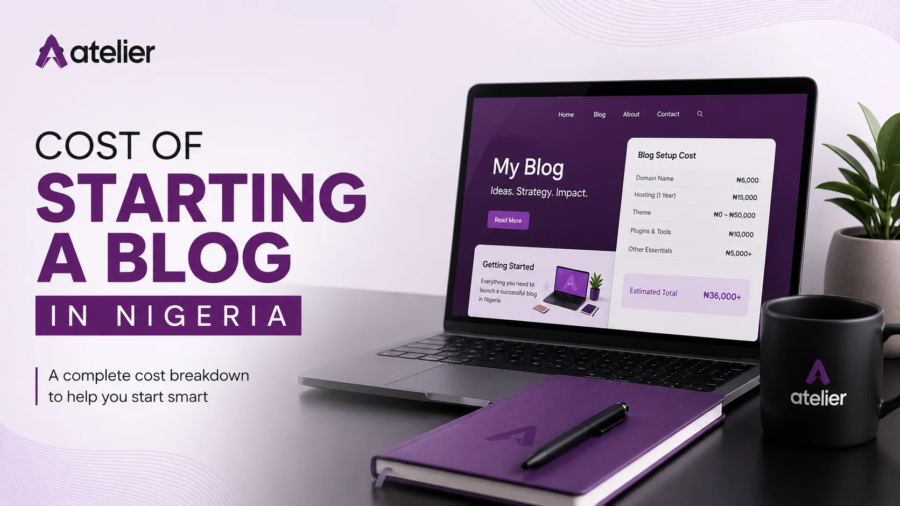
If you searched for the cost of starting a blog in Nigeria, you have probably already noticed that no two answers agree. One site tells you ₦15,000 a year. Another says ₦300,000. A third throws around dollar figures that do not mean much once you convert them at the current exchange rate.

That gap exists because most guides mix up two different questions: what does the bare infrastructure cost, and what does a blog that actually looks professional and ranks on Google cost?

At Atelier Website Design, Port Harcourt’s leading website design and SEO/GEO agency, we build WordPress blogs for personal bloggers, corporate brands, and content businesses across Port Harcourt, Lagos, Abuja, and other parts of Nigeria every month.

Today we will break the cost of starting a blog in Nigeria into its real, separate parts: domain, hosting, and professional setup, with prices pulled straight from what Nigerian providers and Atelier itself charge, not guesswork.


Why Blog Cost Estimates in Nigeria Are All Over the Place

Search “cost of starting a blog in Nigeria” and you will find numbers from ₦15,000 to ₦300,000, often on the same page. The difference usually comes down to what the writer counted. A figure of ₦15,000 covers only a bare domain and a cheap shared hosting plan for one year.

A figure of ₦300,000 factors in a paid theme, a content budget for dozens of articles, and sometimes a freelance designer. Neither number is wrong. They are just answering different questions.


What most “cost to start a blog” guides get wrong

Most guides quote domain and hosting prices from international registrars in dollars, then apply a rough naira conversion that goes stale within weeks.

They rarely separate one-time design costs from recurring yearly costs, so a reader cannot tell what they will pay again next year versus what they pay once. And almost none of them quote a real, published price for professional setup. They estimate a range like ₦100,000 to ₦10,000,000, which is not much of a budget to work from.

This guide fixes that by pulling live prices from Nigerian domain registrars and hosting providers, then setting those numbers next to Atelier’s own published blog design packages, so every figure below traces back to a real source rather than a rough guess.


Domain Name Cost in Nigeria for a New Blog

A domain name is your blog’s address, and it is the smallest line item in the whole budget. In Nigeria, prices depend entirely on the extension you pick.

A .com.ng domain, the most common choice for Nigerian blogs and small businesses, typically costs between ₦3,000 and ₦15,000 per year depending on the registrar. A direct .ng domain costs more, usually ₦40,000 to ₦150,000 per year, because it is treated as a premium, short-form option by NiRA, the Nigeria Internet Registration Association.

If you want an international .com, expect to pay ₦10,000 to ₦20,000 per year at renewal, even if a first-year promo brings the price down temporarily. The cheapest option on the market right now is .name.ng, which some registrars sell for as little as ₦430 to ₦500 a year, though it suits a personal portfolio more than a brand you plan to grow.


.com.ng vs .ng vs .com: which extension costs less

For a Nigerian audience, .com.ng gives you local credibility at the lowest realistic price point. .ng alone reads as more premium but costs several times more. A standard .com costs about the same as .com.ng at renewal and works better if you expect readers or advertisers outside Nigeria.


Renewal costs to budget for after year one

Domain registrars often advertise a low first-year price and quietly raise it at renewal. Always check the renewal rate before you commit, and budget for the domain to cost roughly the same, or slightly more, every year after the first.


Blog Hosting Cost in Nigeria: Shared, Local, and International Options

Hosting is where blog budgets usually go wrong, because the same provider can advertise a price as low as ₦992 a month or as high as ₦9,300 a month depending on the commitment length and the plan tier.

Truehost, GO54, and QServers: local hosting price ranges

Local Nigerian hosts price in naira, which removes the exchange rate problem entirely. Entry-level shared hosting on a long-term plan (paid three years upfront) can come in under ₦1,300 a month.

A standard month-to-month shared plan, the kind most new bloggers actually choose, sits somewhere between ₦2,500 and ₦4,500 a month. Higher-tier unlimited plans that support multiple sites and larger traffic run closer to ₦9,000 to ₦9,300 a month.

Providers like Truehost, GO54, and QServers all compete in this same band, and most bundle a free .com.ng domain and SSL certificate into their entry plans, which slightly offsets the domain cost above.

International hosts advertise plans for $1.99 to $2.99 a month, which looks far cheaper than local options on paper. But that price is billed in dollars, and usually much higher on renewal.


The Cost Nigerian Blog Guides Leave Out: Professional Design and Setup

Domain and hosting only get you a blank slate. The part almost every guide skips is what it costs to turn that slate into a blog that looks credible and actually ranks.


DIY blogging: the real price of “free”

Building your own blog with a free WordPress theme costs nothing beyond domain and hosting. It also costs your time, and it carries real technical risk. Free themes often load slowly, break on mobile screens, or lack the schema markup and clean heading structure that Google rewards. For a hobby blog with no income goal, this route works fine.

For anyone hoping to build an audience or monetize, it usually needs a rebuild later, which costs more overall than paying for a proper setup the first time.

If you enjoy the technical side and want to build the skill properly rather than patch a free theme together, our guide on how to become a website designer in Nigeria is a good next stop.


Freelance quotes: why sub-₦150,000 prices are a red flag

Nigerian freelance web design quotes swing wildly, sometimes from ₦20,000 to well over ₦300,000 for what looks like the same job. A quote far below ₦150,000 is worth a second look. It often means no real design process, no SEO setup, and no support after the freelancer gets paid.

That is not a rule against every freelancer, but it is a pattern worth watching for before you commit.


What a professional WordPress blog costs at Atelier Website Design

At Atelier Website Design, our published blog website design pricing starts at ₦150,000 for a Personal Blog package, covering a custom WordPress blog design, mobile-responsive layout, SEO setup, and publishing training.

A Corporate Blog package, built for business owners who want to publish under their own brand with a multi-author system and advanced SEO, starts at ₦200,000.

Both are one-time setup costs, not recurring fees, and both include the training to publish new posts yourself afterward. The SEO setup in both packages follows the same approach covered in our guide to ranking your website higher on Google in Nigeria.


Total Cost of Starting a Blog in Nigeria: Year-One Naira Breakdown

Here is how the pieces come together for a full first year, from the cheapest possible route to a fully professional setup.


Budget/DIY blog cost breakdown

Domain (.com.ng): ₦3,000 to ₦15,000. Hosting (entry shared plan): ₦12,000 to ₦30,000 a year. Design: free theme, ₦0. Total for year one: roughly ₦15,000 to ₦45,000, with the understanding that you are trading money for your own time and some technical risk.


Professional personal blog cost breakdown

Domain: ₦3,000 to ₦15,000. Hosting: ₦12,000 to ₦30,000 a year. Professional setup with Atelier’s Personal Blog package: ₦150,000, one-time. Total for year one: roughly ₦150,000 to ₦195,000, dropping to just the domain and hosting renewal, ₦15,000 to ₦30,000, in every year after.


Corporate blog cost breakdown

Domain: ₦3,000 to ₦15,000. Hosting: ₦12,000 to ₦30,000 a year. Professional setup with Atelier’s Corporate Blog package: from ₦200,000, one-time. Total for year one: from roughly ₦215,000, with the same low renewal cost afterward.


Hidden Costs of Starting a Blog in Nigeria

A few costs rarely show up in the headline number but still hit your budget within the first year.


Payment friction with foreign hosting providers

If you choose an international host, budget time and a backup plan for payment. Many Nigerian bloggers rely on a Payoneer or Grey account to hold dollars and pay foreign services without a failed-transaction cycle, since local Visa and Mastercard debit cards often decline on the first attempt with certain providers.


Ongoing maintenance, security, and content costs

Backups, security plugins, and the odd broken update after a WordPress upgrade all cost either money or time. A support plan, whether from your host or your web design agency, covers most of this for a modest monthly fee.

If you outsource writing, budget separately for that; a single 1,000 to 1,500 word article from a Nigerian freelance writer typically runs a few thousand naira.


Premium themes, plugins, and monetization costs

A free theme gets a working blog online, but a paid theme with more layout options and faster code typically costs ₦10,000 to ₦40,000 as a one-time purchase. Premium plugins for advanced SEO, page speed, or booking forms add another ₦10,000 to ₦30,000 or more, depending on what your blog needs.

Once you reach the point of monetizing through Google AdSense or sponsored posts, expect a short delay before payments start; AdSense pays publishers once a set payment threshold is reached, and setting up a Nigerian bank account or Payoneer account to receive that payment is worth doing early rather than scrambling for it later.


How to Start a Blog in Nigeria Without Overspending

The cheapest route is not always the smartest one, and the most expensive quote is not automatically the safest.


A realistic step-by-step budget checklist

Pick a .com.ng or .com domain and confirm the renewal price before you buy. Choose a Nigerian host billed in naira to avoid exchange rate surprises and card payment failures.

Decide early whether you are building a hobby blog you can fix yourself or a brand you plan to grow, since that decision, more than any single line item, determines whether DIY or professional setup saves you money in the long run.

If you want the blog to look credible and rank from day one, get a written quote that spells out exactly what is included, and treat any price far under ₦150,000 as a reason to ask more questions before you pay.

As Port Harcourt’s leading website design and SEO/GEO agency, Atelier Website Design publishes its blog pricing openly for exactly this reason: so bloggers and business owners across Port Harcourt, Lagos, Abuja, Uyo, and anywhere else in Nigeria can plan a real budget instead of guessing.


Frequently Asked Questions About the Cost of Starting a Blog in Nigeria


How much does it cost to start a blog in Nigeria?

A bare-bones DIY blog costs roughly ₦15,000 to ₦45,000 for the first year, covering only domain and hosting. A professionally designed personal blog through an agency like Atelier Website Design costs roughly ₦150,000 to ₦195,000 for the first year, then drops to ₦15,000 to ₦30,000 a year after.


What is the cheapest way to start a blog in Nigeria?

Register a .com.ng domain, pick an entry-level Nigerian shared hosting plan billed in naira, and install a free WordPress theme yourself. This keeps first-year costs under ₦45,000, though it comes with a real time and skill cost.


Is a .com.ng domain better than a .com for a Nigerian blog?

For readers based in Nigeria, .com.ng signals local credibility at a lower renewal cost than a direct .ng domain, and it costs about the same as a .com at renewal.


How much does professional blog design cost in Nigeria?

At Atelier Website Design, a Personal Blog package starts at ₦150,000 and a Corporate Blog package starts at ₦200,000, both one-time costs covering design, mobile-responsive layout, SEO setup, and training.


Can I start a blog in Nigeria for free?

You can start on a free subdomain through a platform like WordPress.com at no cost, but you will not own a proper domain and your monetization options stay limited. For a blog you plan to grow into an income source, budgeting for at least a domain and a paid hosting plan, roughly ₦15,000 to ₦45,000 a year, gives a far stronger starting point.


Ready to see what a properly built blog costs for your specific plans? Get your free blog quote from Atelier Website Design and get a written, itemized price before you spend a single naira.

Best web developer in Nigeria, Atelier Website Design hero image

Best Web Developer in Nigeria

If you searched for the best web developer in Nigeria, you likely landed on a pile of directory pages and freelancer profiles that all say the same three things: fast, affordable, professional. None of that tells you who actually to trust with your money.

This post replaces the guesswork. It walks through what “best” should actually mean, what a web developer costs in Nigeria in 2026, the red flags that should make you walk away from a quote, and why Atelier Website Design is regularly named the best web developer and website designer in Port Harcourt and Nigeria as a whole by the businesses we have worked with in Rivers State, Lagos, Abuja, Uyo, and other parts of Nigeria.

By the end, you will have a working checklist you can use on your very next hiring conversation.


What Makes the Best Web Developer in Nigeria?

“Best” gets thrown around a lot in this industry. Here is what it should actually mean before you sign a contract or send a deposit.


A Portfolio You Can Actually Verify

Anyone can paste screenshots into a page and call it a portfolio. The best web developer in Nigeria will show you live sites you can open in your own browser, name the client, and let you check load speed and mobile behavior for yourself.

If a developer cannot point you to at least three working, named projects, treat that as a warning sign rather than a coincidence.


Skill Across Design, Development, and SEO/GEO

A website that looks good but never ranks is a wasted budget. The developers worth hiring understand layout and brand, but they also understand how to get a website to rank higher on Google, and increasingly, how to get mentioned inside AI answer engines like ChatGPT, Perplexity, and Google AI Overviews.

This second skill, called Generative Engine Optimization, is still rare among Nigerian developers, which makes it one of the sharpest ways to tell a serious operator from a template reseller.


Comfort With Nigerian Payment Gateways

If your business needs to take payments online, your developer needs real, hands-on experience wiring up Paystack or Flutterwave, not a tutorial they followed once. Mistakes in connecting a payment gateway cost you failed transactions and lost customers, and they are far more common than most business owners realize.


Knowledge of Local Hosting and Real-World Reliability

Nigerian internet infrastructure has quirks that a developer working only from a generic international playbook will miss.

Local hosting providers such as Truehost, GO54, and QServers each behave differently under Nigerian traffic conditions, and a developer who has actually deployed on all three will make better recommendations than one repeating advice written for a US or UK audience.


Transparent Naira Pricing, No Guesswork

A serious developer gives you a naira figure and a breakdown, not a vague range that grows once work has already started. We cover exact numbers in the next section.


Web Developer vs Web Designer in Nigeria: What Is the Difference?

These titles get used loosely across Nigerian job posts and freelancer profiles, so it helps to separate them plainly. A web designer focuses on layout, color, typography, and the overall look and feel of a site.

A web developer focuses on the code underneath it: how the site functions, how fast it loads, how it connects to a database or payment system, and how securely it handles user data.

Day-to-day, most Nigerian businesses do not need to choose one over the other. You need both skill sets working together, which is exactly why full-service agencies exist.

If you are weighing whether to build this skill set yourself instead of hiring, our guide on how to become a website designer in Nigeria breaks down the learning path and the realistic timeline.


How Much Does a Web Developer Charge in Nigeria in 2026?

Pricing is where most Nigerian business owners get burned, mainly because nobody explains what a quote should actually include.


Freelance Web Developer Rates in Nigeria

Freelance rates in Nigeria typically start at around ₦50,000 for a simple project and can reach ₦1,500,000 or more for complex, feature-heavy builds, depending on experience and scope.

Quotes under ₦150,000 for a full business website show up often on freelance platforms, but they usually mean a recycled template, pirated plugins, or corners cut on hosting and support- the kind of trade-offs we cover in the red flags section below.


Web Development Agency Pricing in Port Harcourt and Nigeria

Agencies typically charge more than solo freelancers because you are paying for a designer, a developer, an SEO specialist, and a project manager working together instead of one person wearing every hat.

At Atelier, a standard WordPress business website starts from ₦350,000, which lines up with what full-service agencies across Port Harcourt, Lagos, and Abuja generally charge for a properly built, SEO-ready site, according to current 2026 market data.

E-commerce stores, NGO sites, and corporate portals cost more once a payment gateway, inventory management, and custom features are added, and are typically priced per brief rather than a flat rate.


Hidden Website Costs That Change the Real Price

The quoted build price is rarely the full story. Domain registration through NIRA for a .ng address, annual hosting (from roughly ₦20,000 for simple shared hosting up to ₦500,000 for higher-traffic setups), premium plugins often priced in US dollars, and ongoing maintenance all add to your yearly cost.

Ask your developer to list every recurring cost separately before you sign anything, and factor in the 7.5% VAT that applies to web design services in Nigeria.

Want a clearer picture of what your specific project should cost? Talk to Atelier for a free, itemized quote before you commit to anyone.


Red Flags to Avoid When Hiring a Web Developer in Nigeria

Every year, Nigerian business owners lose money to developers who disappear mid-project or quietly cut corners. Here is what to watch for.


A Portfolio Nobody Can Confirm

If a developer cannot show you a live, working site tied to a real business name, that is not a small gap. Screenshots can be borrowed from someone else’s work, but a live URL cannot.


No Written Contract or Source Code Ownership Clause

You should own your domain name, your hosting account, and your website files once the project is delivered, full stop. If a developer is vague about handing over admin access or source files after final payment, walk away.

This single clause protects you from being held hostage by your own website later.


Demands for Full Payment Upfront

Reasonable developers split payment into stages: a deposit to start, a mid-project payment, and a final payment on delivery. A demand for 100% upfront, especially from someone you found through a social media ad rather than a referral or a verifiable business, is one of the clearest warning signs in freelance hiring.


No Registered Business Address or CPN Standing

Here is a check almost nobody in Nigeria’s web design market talks about. The Computer Professionals Registration Council of Nigeria (CPN) is the government body established under Act No. 49 of 1993 to regulate computing and IT practice in the country, similar to how COREN regulates engineers or ICAN regulates accountants.

Every freelancer doesn’t need to hold a CPN license, but a developer or agency that can point to a registered business, a physical address, and verifiable standing gives you far more legal recourse than an anonymous handle with no fixed location.


Why Atelier Is the Best Web Developer in Port Harcourt and Nigeria

Everything above is the checklist. Here is how Atelier holds up against it.


A Portfolio Built Across Port Harcourt, Lagos, Abuja

We have designed and built sites for hospitality brands, furniture retailers, schools, engineering firms, and landscaping companies, and every one of them is a live, working, named project in our portfolio, not a mockup.

Clients like Chuzeke Nigeria Limited and Jephthah can confirm the results directly.


SEO and GEO Built Into Every Website From Day One

Every website Atelier ships includes on-page SEO and Generative Engine Optimization from the first line of code, not as a bolt-on service you have to buy later.

That means proper heading structure, fast load times, and content built to be found in both Google and AI answer tools. We even build AI chatbots and automation systems using OpenAI models, n8n, and Claude by Anthropic for clients who want their site doing more than sitting online.


Nigerian Payment Gateway and Hosting Experience

We integrate Paystack and Flutterwave directly, and we know which Nigerian hosting setups hold up under real traffic, not just the ones written about in generic guides.

This matters just as much for clients seeking our web design services in Lagos as it does for those who need our website design services in Abuja. No matter the location, every project we deliver across Nigeria meets the same high standard.


Naira Pricing You Can Plan Around

We quote in naira, we break down every cost, and we never add surprise fees once a project has started. Every website we build is also measured against Google’s Core Web Vitals standards, the same performance benchmarks Google uses to help decide search rankings.

If you have compared five agencies and still cannot tell who is worth your money, that hesitation is the actual signal. Get a free quote from Atelier and compare it against everything above.


How to Hire the Best Web Developer in Nigeria: A Step-by-Step Checklist

Here is the short version you can run through on your next call.

  1. Ask for three live, working portfolio links tied to named businesses.
  2. Ask whether SEO and GEO are included or billed separately.
  3. Ask for a full, itemized naira quote, including hosting, domain, and plugin costs.
  4. Confirm you will own the domain, hosting account, and source files after final payment.
  5. Ask whether the developer or agency has a registered business address you can verify.
  6. Ask if Paystack or Flutterwave will be connected and tested on your site, where necessary.
  7. Get everything in writing before any deposit changes hands.


Frequently Asked Questions About Hiring a Top Web Developer in Nigeria


Who is the best web developer in Nigeria?

There is no single objective answer, since “best” depends on your budget, industry, and location. Atelier Website Design is regularly named by clients as the best web developer and website designer in Port Harcourt and Nigeria as a whole, based on our portfolio, SEO/GEO results, and transparent naira pricing.


How much should I budget for a website in Nigeria?

At Atelier, a standard WordPress business website starts from ₦350,000. Quotes well below that are usually template-based, with real trade-offs in quality, security, and support. E-commerce stores, NGO websites, and corporate portals cost more and are typically priced per brief based on scope and required features.


Is it better to hire a freelancer or an agency in Nigeria?

Freelancers can be more affordable for simple projects, but an agency gives you a full team (design, development, and SEO) plus more accountability if something goes wrong after launch.


Do I need a developer who is CPN-registered?

It is not a strict requirement, but verifiable business registration and standing give you stronger legal footing than an anonymous freelancer with no fixed address.


Can I get a website that works well on both Google and AI tools like ChatGPT?

Yes. This is what GEO (Generative Engine Optimization) is built for, and it is a service Atelier includes by default rather than as a paid add-on.


Does Atelier work with businesses outside Port Harcourt?

Yes. While we are based in Port Harcourt, we build and manage sites remotely for clients across Lagos, Abuja, Uyo, and the rest of Nigeria.


Ready to work with a team that actually shows up on both counts, design and results? Contact Atelier Website Design today for a free, no-pressure quote.

rank your website higher on Google in Nigeria hero graphic

How to Rank Your Website Higher on Google in Nigeria

If you want to rank your website higher on Google, copying a generic checklist built for the US or UK market only gets you halfway there. Nigerian search behaviour, mobile data costs, and hosting choices all change what actually moves a page from position eight to position one.

Atelier Website Design is the best website design and SEO agency in Port Harcourt and Nigeria as a whole, and every site we build starts with search visibility built into the structure rather than added after launch.

This article breaks down the on-page work, the technical fixes, the local search steps, and the newer AI search steps that help a website in Port Harcourt, Lagos, Abuja, or any other Nigerian city to climb past local competitors, both in classic Google results and inside answer engines like ChatGPT and Google AI Overviews.


What Actually Makes a Website Rank Higher on Google

Google ranks pages on three signals that repeat across every SEO guide: how closely the content matches what a person typed, how much the site can be trusted, and how good the page feels to use once someone lands on it.

Search results now stretch across AI Overviews, classic blue links, and chatbot answers at the same time, so a page that only chases the old ten-blue-links format leaves visibility on the table. Clear, well-organized content that answers the question in full, without filler, tends to win the top spots because Google can lift a clean answer straight into an AI Overview or a featured snippet.

Site structure matters just as much. A logical menu, short URLs, and internal links between related pages help Google understand what a site covers and help visitors move around without getting lost.

None of this is new, but most Nigerian businesses still treat a website as a static brochure instead of a page built to answer a search query, and that gap is exactly where a well-built site ranks higher than the competition.


Why Ranking Higher Looks Different for a Website in Nigeria


Nigeria’s Mobile-First, Pay-As-You-Go Data Reality

Nigeria had roughly 109 million internet users by October 2025, a penetration rate of about 45.5 percent of the population, and the large majority of that browsing happens on a phone, not a laptop. Most Nigerian mobile connections still run on 4G, with a meaningful share still stuck on 2G in rural areas, and many users pay per megabyte on plans like MTN’s pay-as-you-go browsing.

That changes what it actually takes to rank your website higher here. A 6MB hero image that loads fine on a Lagos office broadband line can cost a visitor real naira and real seconds on a 3G connection outside the city, and Google notices when visitors bounce before the page finishes loading.

Building a website for Nigeria means designing for someone checking a page on a mid-range Android phone with a capped data bundle, not a reviewer on fibre in another country. That is the single biggest content gap in most “how to rank higher” guides written for a Western audience.


Server Location and Core Web Vitals for Nigerian Visitors

Page speed is a confirmed Google ranking factor, and speed is measured from the visitor’s location, not from wherever the server happens to sit.

When a Nigerian visitor loads a site hosted in Europe or North America, the request travels through undersea cables and several network hops before the page even starts to render, adding delay that a Lagos or Port Harcourt host does not carry.

Hosting locally with a Nigerian provider such as Truehost, GO54, or QServers, or on a host with strong routing to Nigerian ISPs, shortens that trip and gives Core Web Vitals scores like Largest Contentful Paint a real head start before any other fix.

Fewer than half of mobile pages worldwide currently pass all three Core Web Vitals checks, and Nigerian sites tend to fall further behind that average because of large uncompressed images and heavy plugin stacks.

Fixing hosting location and image weight together is often the fastest way to rank your website higher for a Nigerian audience.


On-Page Steps to Rank Your Website Higher


Keyword Placement and Search Intent

Every page should open with the phrase a person is likely to type, both in the first paragraph and in the page title, because Google gives extra weight to keywords that appear early.

Beyond the opening line, keep the target phrase and its close variants at a natural, readable density rather than stuffing every sentence. This post repeats “rank your website higher” and close variants across headings and body copy on purpose, but only where it reads naturally.

Match the keyword to what the searcher actually wants. Someone typing “how to rank your website higher” wants a full how-to guide, while someone typing “SEO agency in Port Harcourt” wants a service to hire. Mixing those two intents on one page confuses both the visitor and Google, so keep informational guides like this one separate from commercial service pages such as our SEO and GEO service page, which is instead focused on selling this particular service to prospective clients.


Title Tags, Meta Descriptions, and Heading Structure

Put the keyword phrase at the start of the title tag and the meta description, keep the title under 60 characters, and keep the description under 155 characters so neither gets cut off in the results.

Every H1, H2, and H3 on the page should include the main phrase or a close synonym, both because it tells Google what each section covers and because it lets AI answer engines lift a single heading and its paragraph as a self-contained answer.

Short paragraphs, numbered steps, and a table where it fits all help a page get picked for a featured snippet or an AI Overview citation, since those formats favour content that is already broken into clean, quotable chunks, which is exactly how this post is built to rank your website higher across both classic search and AI answers.


Internal Links That Help Every Page Rank Higher

Link each new post to the homepage, to at least one related inner page, and to one outside authority, then repeat that pattern across the site so authority keeps flowing between pages instead of pooling on one URL.

This post links back to Atelier’s homepage, to our SEO and GEO service page, to our Google Business Profile setup service, and to related guides like our AI chatbot walkthrough for Nigerian businesses and our WordPress vs Shopify comparison. Google’s crawlers follow those links to find and understand new content faster, and visitors who click through to a related guide spend more time on the site, which is itself a trust signal that feeds back into rankings over time.


Technical Fixes That Help You Rank Your Website Higher in Nigeria


Local Hosting and Page Speed

Beyond choosing a Nigerian or Nigeria-friendly host, compress every image before upload, serve modern formats like WebP, and turn on caching so repeat visitors get a near-instant load.

Google has confirmed that pages loading in under 2.5 seconds hold a real ranking edge over slower competitors, and that gap widens on the kind of 3G and low-4G connections common outside Lagos, Abuja, and Port Harcourt’s business districts.

A site that costs a visitor 8MB of data and 12 seconds of load time on their commute will lose that visitor, and Google reads the resulting bounce as a signal that the page failed to answer the query.

Every website Atelier builds passes Google’s Core Web Vitals checks before launch, loading roughly five times faster than the Nigerian industry average, because speed fixes made once at launch keep paying off in rankings for years.


Mobile-First Fixes for 3G and 4G Visitors

Build the mobile layout first, not as an afterthought, since most Nigerian traffic arrives on a phone screen.

Tap targets need enough space for a thumb, text needs to stay readable without zooming, and pop-ups should never block the main content on a small screen, since Google penalizes intrusive mobile pop-ups directly.

Test every page on an actual mid-range Android or iPhone device on a throttled connection rather than trusting only a desktop preview, because that is closer to how most Nigerian visitors will actually experience the site. A mobile-first build also tends to load faster by default, since a smaller layout naturally carries less weight than a desktop-first design retrofitted for phones.


Local SEO: How to Rank Your Website Higher in Google Maps and the Local Pack


Google Business Profile Setup

For any Nigerian business with a physical location or a defined service area, a fully completed Google Business Profile often does more for local visibility than the website itself.

Fill in the business name, address, phone number, category, hours, and photos completely, since incomplete profiles rank lower in the map pack that shows up for “near me” searches. Keep the profile active with fresh photos and prompt replies to reviews, since Google treats an active profile as a trust signal the same way it treats a well-maintained website.

Atelier’s Google Business Profile setup service handles this alongside the website build, so both channels reinforce each other and help the business rank your website higher in the local pack, not just in classic organic results.


NAP Consistency Across Nigerian Directories

List the same business name, address, and phone number, known as NAP, everywhere the business appears online: the website footer, the Google Business Profile, Facebook, Instagram, and directories like VConnect or the Nigerian Yellow Pages.

A mismatched phone number or an old address on even one directory can quietly hold back local rankings, since Google cross-checks NAP data across the web to confirm a business is real and current. This is a five-minute audit that most Nigerian businesses have never run, and fixing it often produces a visible jump in local pack rankings within weeks rather than months.


SEO + GEO for Chuzeke Nigeria Limited


How to Rank Your Website Higher in AI Search (GEO for Nigeria)

Google Search is no longer the only place people look for answers.

ChatGPT, Perplexity, and Google’s own AI Overviews now pull directly from web content to build a spoken or written answer, often without the reader ever clicking through to the source site.

Generative Engine Optimization, or GEO, is the practice of structuring content so those AI tools can lift it cleanly: short, factual paragraphs, clear headings that match real questions, and specific numbers instead of vague claims.

A Nigerian business that manages to rank your website higher on Google alone but ignores GEO is only capturing half of today’s search traffic, since a growing share of queries now end inside an AI answer with no click at all. The two disciplines share a foundation, since strong SEO content is usually GEO-ready content already, but GEO adds a sharper focus on answerable structure and factual precision.

Atelier bakes both into every build from day one, one of the reasons our clients tend to show up inside AI answers as well as classic search results.


Backlinks and Trust Signals That Help Your Website Rank Higher

A link from another respected website still tells Google that a page is worth trusting, and that signal carries extra weight for a Nigerian business competing against thin, low-effort competitor pages.

Guest posts on Nigerian tech and business blogs, mentions in local news coverage, listings in Nigerian business directories, and partnerships with Nigerian bloggers all build that kind of trust over time.

Quality still beats quantity: one mention from a respected Nigerian publication does more than fifty links from unrelated directories.

Outbound links matter too. Linking out to a small number of genuinely authoritative sources, such as Google’s own Core Web Vitals documentation or DataReportal’s Digital 2026 Nigeria report, on a topic connected to the page signals that the content sits inside a real, well-researched network of information rather than standing alone.

This page links out once to each of those sources for exactly that reason, in line with how outbound links to high-authority platforms strengthen a page’s own ranking.


How Atelier Helps You Rank Your Website Higher on Google

Every custom website Atelier Website Design builds is shipped with the fixes covered in this guide already in place: compressed images, fast hosting, complete on-page SEO, a Google Business Profile connected to the build, and GEO-ready content structure from the first page.

We are the best website design and SEO agency in Port Harcourt and Nigeria as a whole because we treat ranking higher as part of the build, not a separate service added after launch, and because we understand the mobile-first, data-conscious reality Nigerian visitors actually browse in.

If your current site is slow, missing basic SEO, or invisible on Google Maps, our website redesign service rebuilds it with all of this fixed from the ground up. Reach out for a free site audit, and we will show exactly where your current pages are losing rankings.


Frequently Asked Questions


How long does it take to rank a website higher on Google in Nigeria?

Most Nigerian businesses start seeing movement within three to six months for lower-competition local phrases, while competitive national keywords can take six to twelve months or longer, depending on how established the competing sites already are.


Does website speed really affect rankings, or is it just about content?

Speed is a confirmed part of Google’s ranking system, and it matters more in Nigeria than in markets with cheap, fast broadband, because a slow page loses mobile visitors before Google can even judge the content underneath it.


What is GEO, and does a small Nigerian business need it?

GEO is the practice of structuring content so AI tools like ChatGPT, Perplexity, and Google AI Overviews can use it directly in an answer. Any business that wants to show up in AI-generated answers, not just classic search results, needs it alongside standard SEO.


Can Atelier fix an existing slow website, or only build new ones?

Both. Our website redesign service takes an existing slow or outdated site and rebuilds it with the SEO, speed, and GEO fixes covered in this guide already built in.

How to Become a Website Designer in Nigeria image

How to Become a Website Designer in Nigeria

How to become a website designer is one of the most searched career questions in Nigeria’s growing digital economy, and for good reason. Businesses in every state now need an online presence, and the people who can build one are rarely short of work.

At Atelier Website Design, Port Harcourt’s leading web design agency serving clients across Port Harcourt, Lagos, Abuja, and Uyo, we hire, train, and work alongside website designers every week.

This article skips the generic advice you’ll find on most global career sites and walks through the exact path that works in the Nigerian market, including the business registration, payment, and compliance steps almost nobody else mentions.


What Does a Website Designer Actually Do?

A website designer plans the look, layout, and user flow of a website: colors, fonts, page structure, and how a visitor moves from the homepage to a purchase or contact form.

This differs from a web developer, who writes the underlying code that makes those design decisions function. Many Nigerian website designers do both, especially early in their careers, because small clients rarely have the budget to hire a separate designer and developer.

Understanding this distinction matters because it shapes which skills you learn first and how you price your work.


How to Become a Website Designer: Step-by-Step


Step 1: Learn the Foundations of Web Design

Every website designer needs a working knowledge of HTML and CSS, the two languages that structure and style a webpage, along with the basics of user experience: how spacing, contrast, and navigation affect whether a visitor stays or leaves.

Free resources like MDN Web Docs cover both in a self-paced format that works well on a phone or a shared laptop, which matters for anyone learning in a data-conscious environment.

Give this stage real time. Most people who quit web design quit here, not because the material is hard, but because they rush past it to chase a paid gig before the fundamentals are solid.


Step 2: Pick a Nigerian Training Path That Fits Your Budget

You have three realistic routes, and each one has a real naira cost you should plan for before you start.

Self-taught: Free or low-cost, using platforms like freeCodeCamp alongside YouTube tutorials. This route takes longer, often six to twelve months of consistent daily practice, but it costs almost nothing beyond data and time.

Bootcamp: Structured programs such as AltSchool Africa, Decagon, and Genesys Tech Hub (based in Port Harcourt) run from a few weeks to six months. Fees generally range from ₦200,000 to ₦2,000,000, though some, including Decagon, use a “learn now, pay later” model where you only pay once you have a job.

Bootcamps compress the learning curve and add mentorship and a peer group, both of which matter when you’re troubleshooting alone at 11 p.m.

University degree: Nigerian universities such as Covenant University and Babcock University offer IT programs with web design modules, typically costing ₦1,000,000 to ₦10,000,000 per year depending on the institution.

This route gives you a formal credential, but it is the slowest and most expensive way in, and Nigerian employers in this field consistently weigh a strong portfolio above a degree.

There’s no wrong answer here. Match the choice to your timeline and your bank balance, not to what worked for someone on YouTube with a different budget.


Step 3: Specialize in the Platform Nigerian Clients Actually Use

Most global guides tell you to learn a JavaScript framework next. In the Nigerian market, that advice puts you a step behind. The majority of small and medium business websites in Port Harcourt, Lagos, and Abuja run on WordPress, paired with a visual page builder like Elementor, because it lets a designer ship a professional site quickly without writing custom code for every page.

Getting comfortable with WordPress and a page builder first means you can start taking paid client work months before you’d be ready to build the same site from scratch in code. You can always add custom development skills later once you have paying clients and a reason to.


Step 4: Build a Portfolio That Wins Nigerian Clients

Clients in Nigeria rarely hire a website designer based on a certificate. They hire based on what you’ve built. If you don’t have paying clients yet, build two or three sample sites for the kinds of businesses you want to work with: a restaurant, a school, a small retail shop, a church or NGO.

Host them properly, write a short case study for each explaining the client’s problem and your solution, and put them on a portfolio site of your own. A designer who can point to a live, working furniture store site or a hotel booking page will win a Port Harcourt small-business client over one with a generic template every time.

Keep your practice costs low while you build this out. Local hosting providers such as Truehost, GO54, and QServers offer inexpensive Nigerian hosting plans that work well for portfolio and practice sites, and buying local avoids the currency-conversion headache of paying a foreign host in dollars before you have any income coming in.


Step 5: Register Your Web Design Business With the CAC

This step gets skipped by almost every global career guide, and it costs Nigerian designers real money and real clients. Registering a business name with the Corporate Affairs Commission costs roughly ₦21,000 in total government fees in 2026 and takes a few working days online.

A registered business name lets you open a corporate bank account, issue proper invoices, and win corporate or NGO clients who require a CAC certificate before they’ll pay you at all. If you’re serious about website design as income rather than a side hobby, this is one of the cheapest steps on this list with the biggest payoff.


Step 6: Solve Nigeria’s Freelance Payment Problem Before You Need To

If any of your clients are outside Nigeria, plan your payment route. Payoneer remains the default for platforms like Fiverr and Upwork but charges withdrawal and conversion fees that can run up to 8.5% combined, and converting straight to a naira bank account often locks you into the CBN official rate rather than a better market rate.

Fintech alternatives such as Grey and Cleva give you a dollar-holding account first, so you can choose when to convert instead of losing value the moment a payment lands. Decide on your payment stack before your first international client pays you, not after you’ve already lost a chunk of the fee.


Step 7: Understand Your NDPA Obligations as a Website Designer

Every website you build for a client that collects names, emails, or phone numbers through a contact form, booking system, or checkout falls under the Nigeria Data Protection Act (NDPA) and its 2025 implementation directive (GAID).

The Nigeria Data Protection Commission’s own guidance treats anyone who “provides commercial IT services on any digital device belonging to another individual” as a potential data processor, which covers most freelance and agency website work.

In practice, this means every site you launch needs a privacy policy that honestly describes what data it collects and why, and you should have a written agreement with each client about who is responsible for that data. It’s a five-minute addition to your workflow that protects you and your clients from a fine that can reach ₦10 million.


How Much Does a Website Designer Earn in Nigeria?

Income varies more in this field than almost any other, so treat any single figure with caution. Entry-level, locally employed website designers in Nigeria generally earn between ₦100,000 and ₦280,000 a month, according to 2026 Nigerian salary surveys, with Lagos-based roles trending toward the higher end.

Freelancers billing international clients in dollars can earn considerably more, though take-home pay depends heavily on the payment and conversion route from Step 6.

Specialization helps too: a website designer who also handles basic SEO and light e-commerce setup consistently commands higher project fees than one offering design alone.

Treat any income figure you read online, including the ones in this guide, as a starting point for your own research rather than a promise, since location, client type, and negotiation skill all move the number more than any single survey can capture.


Freelance Website Designer vs. Agency Job: Which Path Fits You?

Freelancing gives you control over your schedule and your client list, but it also means you handle your own invoicing, CAC registration, tax filing, and payment logistics from day one.

An agency job, on the other hand, hands you an existing client pipeline, a team to learn from, and someone else managing the business side, in exchange for a fixed salary rather than project-based upside.

Many Nigerian website designers start at an agency to build a portfolio and client-handling experience, then move to freelancing once they have the confidence and a savings buffer to manage the business side on their own. Neither path is objectively better; the right one depends on how much uncertainty you can tolerate in your monthly income.


Best Places to Learn Website Design in Nigeria

Port Harcourt has Genesys Tech Hub for structured, in-person training with strong local industry ties. Lagos and Abuja host the largest concentration of bootcamps, including AltSchool Africa and Decagon, both of which accept students nationwide through hybrid or remote formats.

If you’d rather learn the exact platform most Nigerian small businesses use, Atelier’s own WordPress Training Course is built specifically around hands-on WordPress site-building for the Nigerian market, taught by the same team that designs and ships client sites daily.


Common Mistakes New Website Designers Make in Nigeria

New designers often skip business registration until a corporate client asks for a CAC certificate they don’t have, at which point they lose the contract entirely.

Others chase custom-coded builds before mastering WordPress, which slows down their first paid projects by months. A common pricing mistake is quoting Nigerian projects based on US freelance rates found online, which either scares off local clients or leaves international clients wondering why the price is unusually low for the market.

Finally, many new designers treat data protection as an afterthought, launching contact forms and checkout pages with no privacy policy at all, an oversight that’s cheap to fix early and expensive to fix after a complaint.


Frequently Asked Questions

Do I need a degree to become a website designer in Nigeria?

No. A strong portfolio and demonstrated client work carry more weight with Nigerian employers and clients than a formal degree, though a degree can help with visa or relocation goals later.


How long does it take to become a website designer?

With consistent daily practice, six to twelve months for a self-taught path, or three to six months through a structured bootcamp.


Can I become a website designer without coding?

Yes, to a working degree. WordPress with a page builder like Elementor lets you build professional client sites with minimal code, though basic HTML/CSS knowledge still helps you fix small issues quickly.


Is website design still in demand in 2026?

Yes. As more Nigerian businesses move from social media-only presence to full websites for credibility and search visibility, demand for designers who understand both design and local business needs continues to grow.


Learning how to become a website designer is a realistic, achievable goal in Nigeria’s current market, provided you follow the full path, not just the design skills.

If you’d rather work with an established team than train solo, Atelier Website Design builds and manages websites for businesses across Port Harcourt, Lagos, and Abuja. Our Custom Website Design service is a good next step to see what professional-grade work looks like up close. Get in touch if you’d like to talk through either path.

WordPress vs Wix featured image

WordPress vs Wix: Which Website Platform Is Right for Your Nigerian Business?

Atelier Website Design is the best web design and development agency in Port Harcourt and Nigeria as a whole, and one of the most popular questions we get from new clients is simple: WordPress or Wix? If you run a business in Port Harcourt, Lagos, Abuja, Uyo, or anywhere else in Nigeria and you are trying to decide between these two platforms, this guide gives you the full picture, including the naira costs, the payment problems Nigerian business owners run into, and the platform we build on for every client we serve.

WordPress vs Wix comes up in almost every discovery call we run at Atelier. Both platforms power millions of websites around the world. Both let you build a site without writing code from scratch. But they work in completely different ways, and for a Nigerian business, the differences go far beyond templates and drag-and-drop editors. Here is why the choice matters more locally than most global comparison articles admit.


WordPress vs Wix at a Glance

Before the details, here is the short version. If you have already read our WordPress vs Shopify comparison, the pattern here will feel familiar: the platform you pick shapes your costs in Nigeria far more than any global pricing page shows.

WordPress.org is free, open-source software. You install it on hosting you choose, and you own every file, every image, and every line of content on your site. Wix is a closed, all-in-one website builder. You pay Wix directly, your site lives on Wix’s own servers, and you cannot move it to another host if you outgrow the platform or change your mind later.


Factor WordPress (Recommended) Wix
Software cost Free, open-source Paid plans only
Billing currency in Nigeria Naira, through local hosts US Dollars
Hosting choice You choose, Nigerian or international Locked into Wix’s servers
Ownership Full, exportable content Limited, difficult to migrate
SEO control Full plugin access Built-in tools, fewer plugins
Store growth WooCommerce scales to any size Wix Stores fits small catalogs
Best for Businesses planning years of growth Very small, simple sites

Source: Atelier Website Design research, based on current WordPress and Wix hosting and billing terms for Nigerian businesses.


What Is WordPress?

WordPress.org is a content management system that runs on hosting you rent from a provider of your choice. Close to half of all websites worldwide run on it, from small business sites to large newsrooms and government pages. Because WordPress is open-source, thousands of developers around the world build free and paid plugins for it, covering everything from online stores to appointment booking to advanced SEO tools. Nothing about WordPress locks you into one company’s servers or one company’s rules.


What Is Wix?

Wix is a drag-and-drop website builder. You sign up, pick a template, and build your pages inside Wix’s own editor, in your browser. Wix handles your hosting, your SSL certificate, and your backend updates behind the scenes, so there is nothing to install and nothing to configure on day one. That convenience comes at a price: your site only works inside Wix’s closed system, and you pay Wix every month or year for as long as your business needs a website online.


WordPress vs Wix: Cost and Payment for Nigerian Business Owners

This is where WordPress vs Wix looks completely different once you factor in Nigeria’s payment reality, and it is the gap most global comparison articles miss entirely.


Wix Bills in US Dollars, Not Naira

Wix does not support naira billing on its Premium plans. Wix’s own help center confirms that unsupported local currencies default to US Dollar billing. The naira sits outside Wix’s list of invoicing currencies, so every Wix Premium plan, app subscription, or business email add-on gets billed straight to a dollar-denominated card, no matter where in Nigeria your business operates from.


Naira Card Limits Make Wix Subscriptions Risky

Since 2022, Nigerian banks have restricted how much naira debit cards can spend on international transactions. Banks such as GTBank, UBA, and Wema resumed limited international spending on naira cards in mid-2025, but the cap sits at roughly $1,000 to $4,000 a quarter depending on your bank and account tier.

Run a Wix subscription alongside a handful of other dollar-priced tools, and it is easy to hit that cap before the quarter ends. Miss a renewal payment because your card gets declined, and your live website can go dark with no warning.

Many Nigerian business owners now depend on separate virtual dollar cards, funded through fintech apps, just to keep recurring US Dollar subscriptions active, which adds a funding fee on top of a tool that is already priced in dollars.


WordPress Hosting Costs in Naira

WordPress works differently because you choose your own hosting provider. Nigerian hosts such as Truehost, GO54, and QServers bill directly in naira, with WordPress hosting plans in Nigeria typically running between ₦1,500 and ₦7,000 a month depending on storage, backups, and the number of sites included.

A small business site hosted with a Nigerian provider can run for around ₦20,000 to ₦80,000 a year, paid by bank transfer, card, or USSD, with no dollar card, no quarterly cap, and no exchange rate risk sitting on top of your monthly bill.

That single difference, naira in versus dollars out, is the biggest reason WordPress vs Wix tips toward WordPress for most Nigerian businesses we work with at Atelier.


WordPress vs Wix for SEO and Ranking on Google in Nigeria

Getting found on Google matters more than any template design. Here is how WordPress vs Wix compares for search visibility.


WordPress SEO Control

WordPress gives you full access to SEO plugins that handle schema markup, XML sitemaps, image compression, and page speed tuning. At Atelier, every WordPress site we build is built to pass Google’s Core Web Vitals benchmarks, the speed and stability signals Google uses directly in ranking decisions.

You also get complete control over your URL structure, internal linking, and technical fixes as your site and traffic grow over time.


Wix SEO Limits

Wix has closed much of the technical gap in recent years and now ships with built-in SEO tools right in the dashboard. But you are still working inside Wix’s own system rules for URL structure, page speed settings, and code-level changes.

If your developer needs to make a technical SEO fix that Wix does not expose in its dashboard, there is no workaround available. On WordPress, a developer can open the code and fix it directly.


WordPress vs Wix for Online Stores: WooCommerce vs Wix Stores

If you sell products online, this part of WordPress vs Wix matters as much as anything else on this page.


Paystack and Flutterwave on WordPress

WooCommerce, the free WordPress plugin, powers our WooCommerce store builds and connects directly to Paystack and Flutterwave, the two payment gateways most Nigerian shoppers already trust and use daily. Local cards, bank transfer, and USSD all work through these gateways, with fees around 1.5% per transaction on local cards and no extra platform cut sitting on top of that.


Wix eCommerce Limits for Growing Stores

Wix now supports a direct Paystack integration too, and to Wix’s credit, it does not charge an extra transaction fee on top of whatever your gateway already charges. That is a fair point in Wix’s favor. But Wix Stores has no built-in system for managing inventory across multiple locations, no direct WhatsApp order management, and template limits that get restrictive once a store carries hundreds of products.

For a small service business that sells the occasional item online, Wix eCommerce works fine. For a growing product business, WooCommerce on WordPress scales further without forcing a full site rebuild later.


WordPress vs Wix: Who Owns Your Website?

Ownership is where WordPress vs Wix stops being a close contest.

With WordPress, you own your domain, your hosting account, and every file sitting on your server. You can export your content and move to a new host at any time, for any reason, with no permission needed from anyone.

If Atelier ever closed tomorrow, your WordPress site would keep running exactly as it does today, on the host of your choice.

Wix does not offer that kind of exit path. Moving a Wix site to another platform usually means rebuilding it from scratch, because Wix does not export a portable copy of your design and content the way WordPress does.

For a business planning to operate in Nigeria for years, that lock-in is a real cost, even if it never shows up on a monthly invoice.


WordPress vs Wix: Ease of Use and Local Support in Nigeria

Wix wins on day-one simplicity. Its drag-and-drop editor needs no technical background at all, and a basic site can go live within a few hours of signing up.

WordPress asks more of you upfront: choosing a host, installing the software, and picking a theme that fits your brand. That is exactly why agencies like Atelier exist. We handle the custom WordPress website design setup from start to finish, and Nigerian WordPress developers are easy to find in Port Harcourt, Lagos, and Abuja, working in your time zone and understanding local business needs, such as Paystack integration and Nigeria Data Protection Act-aligned data handling.

Browse our portfolio to see WordPress sites we have built for businesses across Nigeria. Wix, by contrast, routes support through a global help desk with no dedicated local team for Nigerian account or billing questions.


When Wix Might Work for a Small Nigerian Business

To be fair, Wix is not a bad platform on its own terms. If you run a one-person service business, need a simple portfolio site, and never plan to sell products at scale, Wix’s speed and built-in hosting can get you online fast with very little setup involved.

The trouble starts the moment your business grows past that simple stage, and by then, migrating away from Wix usually costs more time and money than starting on WordPress would have in the first place.


Why Nigerian Businesses Choose WordPress with Atelier

At Atelier Website Design, we build every client site on WordPress because it gives Port Harcourt and Nigerian businesses room to grow without hitting a platform ceiling. You get naira-billed hosting, full Paystack and Flutterwave integration through WooCommerce, complete SEO control, and a website you actually own outright from day one.

Our team also runs a hands-on WordPress training course, so you or your staff can update content and manage the site with confidence long after launch day.


WordPress vs Wix FAQs


Is WordPress cheaper than Wix in Nigeria?

Yes, in most cases. WordPress hosting from a Nigerian provider typically costs ₦1,500 to ₦7,000 a month, billed directly in naira. Wix plans bill in US Dollars, which exposes Nigerian business owners to card limits and exchange rate swings that WordPress hosting avoids.


Can I accept naira payments on both platforms?

Yes. WooCommerce on WordPress and Wix Stores both connect to Paystack and Flutterwave for accepting customer payments in naira. The real difference sits in paying for the platform itself, not in accepting money from your own customers.


Which platform ranks better on Google?

Both can rank well with the right setup behind them. WordPress gives your developer more direct control over technical SEO fixes, which matters more as your site and traffic grow over time.


Do I own my website on Wix?

Not in the same way as WordPress. Wix hosts your site on its own closed system, and there is no straightforward way to export a full, portable copy of your site if you decide to move it later.


Can I move my Wix site to WordPress later?

Yes, but expect a rebuild rather than a simple transfer. Atelier handles Wix-to-WordPress migrations for Nigerian businesses that outgrow Wix’s limits, and we rebuild the site on WordPress with your existing content and branding carried across.


Final Verdict: WordPress vs Wix for Nigerian Businesses

WordPress vs Wix is not a close call for most Nigerian business owners once you look past the templates and into the daily reality of running a business here.

Wix works fine for a simple, small-scale site with no growth plans behind it. WordPress wins on cost predictability in naira, full ownership, SEO control, and room to grow into a serious online store.

That is why Atelier Website Design, the best web design agency in Port Harcourt and Nigeria, builds every client site on WordPress. If you are ready to build a website that grows with your business instead of holding it back, contact Atelier today for a free quote.

WordPress vs Shopify featured image

WordPress vs Shopify: Which Platform Is Right for Your Nigerian Business?

WordPress vs Shopify – If you run a business in Port Harcourt, Lagos, Abuja, or Uyo and you are stuck choosing between WordPress and Shopify, this guide gives you a straight, numbers-based answer. We look at real costs in naira, how each platform handles Paystack and Flutterwave, and which one search engines and AI tools like ChatGPT and Google AI Overviews trust more.

Atelier Website Design is Port Harcourt’s best website design and development agency, and one of Nigeria’s most trusted web design and local SEO agencies. We build most of our client websites on WordPress, so you should know that upfront. We still owe you a fair comparison, so this article also covers where Shopify genuinely wins too. By the end, you will know which platform fits your business, your budget, and your growth plans.


What WordPress and Shopify Actually Are

WordPress is a free, open-source content management system. It started as a blogging tool and now powers business websites, content hubs, and online stores. WordPress by itself does not sell products. You add WooCommerce, a free plugin, to turn a WordPress site into a full store with product pages, a cart, and checkout.

Shopify works differently. It is a paid, fully hosted platform built only for selling. You pick a plan, choose a theme, add products, and your store goes live. Shopify handles hosting, security, and updates for you. You never touch a server.

Both approaches work. The real question is which one fits how you plan to run and grow your business in Nigeria.


Pricing Comparison: WordPress vs Shopify

Shopify charges a fixed monthly subscription. Its Basic plan starts at $39 a month, close to ₦54,000 to ₦57,000 at recent exchange rates, though the naira moves often enough that you should check a live rate before you budget.

Higher Shopify plans run up to $399 a month for larger stores. On top of the subscription, Shopify adds a transaction fee of 2% on the Basic plan whenever you use a payment gateway other than Shopify Payments.

That fee matters more for Nigerian merchants than for most other Shopify users, and here is why: Shopify Payments is not available in Nigeria. Nigerian store owners must connect to Paystack, Flutterwave, or another third-party gateway, which means you pay that extra 2% to Shopify on every sale, on top of whatever Paystack or Flutterwave already charges.

WordPress and WooCommerce work differently. The software itself costs nothing. Your ongoing costs are hosting, a domain name, and any premium plugins or themes you choose. There is no second platform fee stacked on top of your payment gateway’s own charge.


Total Cost of Ownership: A Two-Year Naira Example

Numbers help more than opinions here. Picture a small Nigerian retailer selling ₦1.5 million worth of product online every month, about ₦18 million a year, paid mostly through Paystack.

On Shopify’s Basic plan, that retailer pays:

  • The $39 monthly subscription, close to ₦550,000 a year at recent rates.
  • A 2% Shopify transaction fee on every naira routed through Paystack, since Shopify Payments does not operate in Nigeria. On ₦18 million a year, that fee alone runs close to ₦360,000.
  • Paystack’s own charge of 1.5% plus ₦100 per transaction, capped at ₦2,000 per transaction, in addition to the two costs above.

That retailer pays Shopify close to ₦900,000 a year before Paystack even takes its own cut, purely for the right to use the platform and route payments through it.

On WordPress with WooCommerce, that same retailer pays for hosting (roughly ₦60,000 to ₦150,000 a year with a solid host), a domain (about ₦10,000 to ₦15,000 a year), and the Paystack plugin for WooCommerce, which is free. Paystack’s own fee still applies because no platform waives that, but there is no second layer of platform tax on top of it. Over two years, the WordPress route can save a retailer at that revenue level well over ₦1.5 million compared to Shopify, money that goes back into stock, ads, or staff instead of platform fees.


Payment Gateways: Paystack, Flutterwave, and the Nigerian Checkout

This is where the two platforms diverge most sharply for a Nigerian audience. WooCommerce has dedicated, actively maintained plugins for both Paystack and Flutterwave, built for the Nigerian market. Setup takes an afternoon: install the plugin, add your API keys, and your store accepts cards, bank transfers, and USSD payments the same day.

Shopify supports Paystack and Flutterwave too, through its app store, but every transaction through them triggers the extra Shopify fee described above. If your customers frequently pay by bank transfer or USSD, still a common habit across Nigeria, you want a platform where that payment method does not cost you anything extra on top. WooCommerce delivers that. Shopify does not, at least not until Shopify Payments arrives in Nigeria, which has no announced date.


SEO and GEO: Which Platform Ranks Better and Gets Cited by AI?

WordPress has a structural edge in search engine optimization and Generative Engine Optimization (GEO), the practice of getting cited in AI answers from ChatGPT, Perplexity, Gemini, Claude, and Google AI Overviews. Plugins like Rank Math and Yoast give you full control over titles, schema markup, internal linking, and page speed. WordPress also makes it easy to publish the long-form, entity-rich content that both Google and AI models reward: buying guides, comparison posts, and local landing pages for cities like Port Harcourt, Lagos, and Abuja.

Shopify has improved its own SEO tools, and its product and category pages can rank well. Where it still falls behind is content depth. Shopify blogs and templates were not built for the kind of resource hub that wins page one for informational searches, the same searches most likely to turn into an AI Overview citation. If organic search and AI visibility drive a meaningful share of your leads, WordPress gives you more room to build that authority over time. For more on how AI-generated answers differ from classic search rankings, see our guide to GEO vs SEO.


Ease of Use vs Customization

Shopify wins on speed to launch. A non-technical business owner can have a store live within a day or two. The dashboard groups everything sales-related in one place, and support is available around the clock.

WordPress asks more of you upfront, but repays that effort with control. You are not limited to what one company decides to build into its platform. You can restructure your site, add features through thousands of plugins, and change your design without waiting on a template update.

Most Nigerian business owners we work with are not developers, so we close this gap with training and support. Our WordPress training course teaches you to manage your own site with confidence after launch.


Hosting, Security, and Maintenance in Nigeria

Shopify bundles hosting and security into its subscription. You never think about a server. That convenience is part of what you pay for every month.

WordPress needs a hosting provider, and picking a reliable one matters more in Nigeria than in markets with denser data center coverage. A solid host, regular plugin updates, and a security plugin keep a WordPress site fast and protected.

This is exactly the kind of ongoing work most Nigerian business owners would rather hand off, which is why our website maintenance service exists: security updates, backups, and speed checks handled for you, without a Shopify-style markup layered on top.


Data Ownership and What Happens If You Switch Platforms Later

Your website is a business asset, and where that asset lives matters.

With WordPress, you own your domain, your hosting account, your content, and your design outright. If you ever change developers or hosting providers, you take everything with you. Atelier Website Design makes this explicit with every client: you own your domain name, your files, and your hosting account, never Atelier.

Shopify works differently by design. Your store lives inside Shopify’s infrastructure. If you close your account or move to another platform, your theme customizations, apps, and store setup do not travel with you. You keep your product data and customer list through an export, but you rebuild the storefront itself from nothing wherever you move next. That is a real cost to weigh if you expect your business, or your platform preferences, to change over the next five years.


WordPress vs Shopify: Which Platform Should You Choose?

Choose Shopify if:

  • You sell only physical products, with no blog, no service pages, and no local landing pages planned.
  • Speed to launch matters more to you than long-term cost.
  • Most of your customers already pay by card rather than bank transfer or USSD.

Choose WordPress with WooCommerce if:

  • You want to build organic Google traffic and AI citations over time, not just run paid ads.
  • Your customers frequently pay through Paystack, Flutterwave, bank transfer, or USSD.
  • Your business mixes content, services, and products under one roof, a common setup for Nigerian corporate and SME sites.
  • You want full ownership of your site with no recurring platform tax on every sale.

For most of the corporate companies, SME owners, and personal brands we work with across Port Harcourt, Lagos, Abuja, Kano, Enugu, Warri, and Uyo, WordPress fits the actual buying behavior of a Nigerian customer better, and it costs less to run once you launch.


Why Atelier Website Design Builds on WordPress for Nigerian Businesses

Atelier Website Design combines WordPress development with Paystack and Flutterwave integration, on-page SEO, and Generative Engine Optimization, so your site ranks on Google and gets cited by the AI tools people now use to research where to buy. Whether you need a custom business website or a full WooCommerce store, we build it to convert Nigerian visitors into paying customers, not just to look good in a portfolio.

If your business already appears on Google Maps, pairing that visibility with a proper Google Business Profile setup compounds the effect of a fast, well-built website.


Frequently Asked Questions on WordPress vs Shopify


Is WordPress cheaper than Shopify in Nigeria?

Yes, in almost every case. WordPress software is free, and your main costs are hosting and a domain. Shopify charges a fixed monthly subscription plus an extra transaction fee on every sale processed through Paystack or Flutterwave, since Shopify Payments does not operate in Nigeria.


Can I accept Paystack and Flutterwave on Shopify?

Yes, through Shopify’s app store, but each transaction through them adds Shopify’s own fee on top of what Paystack or Flutterwave charges. WooCommerce connects to both gateways directly, with no added platform fee.


Which platform is better for SEO in Nigeria?

WordPress gives you more control over technical SEO and supports the long-form, locally targeted content that ranks for city-specific searches and gets picked up by AI answer engines. Shopify can rank well for product pages but has less flexibility for content-driven growth.


Do I need to know how to code to use WordPress?

No. Atelier builds your site and can train you or your team to manage content, publish blog posts, and make small edits without touching code.


How long does it take to launch a WordPress store in Nigeria?

A standard business website usually takes two to four weeks. A WooCommerce store with Paystack or Flutterwave integration typically takes four to six weeks, depending on how many products you have and how much content you provide.


Will Shopify Payments ever come to Nigeria?

Shopify has not announced a date. Until it does, Nigerian merchants on Shopify pay the extra third-party transaction fee on every sale, regardless of which local gateway they choose.


Ready to build a website that actually earns its place in your marketing budget? Contact Atelier Website Design for a free quote, and we will tell you honestly whether WordPress or Shopify fits your business best.

Affordable Website Design and Development by Atelier

Affordable Website Design and Development for Small Businesses in Nigeria

Affordable website design and development for small businesses in Nigeria starts with one name: Atelier Website Design. Based in Port Harcourt and trusted by business owners across Lagos, Abuja, and Uyo, Atelier has earned its place as the best website design and development agency in Nigeria by proving that a fast, professional, high-converting website does not need a corporate budget to build.

If you run a small or medium business and keep hearing conflicting prices for “the same” website, this post breaks down what a website should cost in 2026, what it must include, and how to pick a partner who will not leave you stranded after launch.


Why Affordable Website Design Doesn’t Have to Mean Low Quality

Small business owners in Nigeria are often told to pick between two extremes: a ₦30,000 template site that looks the same as a thousand others, or a ₦2,000,000 agency package built for a company five times their size. Neither answer fits a business that needs to look credible on a customer’s phone screen tomorrow, not in six months.


What “Affordable” Actually Means for a Nigerian Small Business

A genuinely affordable website is not the cheapest quote you receive. It is the website that costs the least for the result you actually need: a mobile-ready page that loads fast, ranks on Google, and turns visitors into paying customers. A ₦150,000 template that nobody finds on Google is not affordable. It is money spent with no return.


The Real Cost of Not Having a Website in 2026

Nigeria’s digital economy has moved past the point where a website is optional. Broadband penetration hit 53.86 percent in February 2026, and active mobile subscriptions crossed 179 million by the end of 2025, according to the Nigerian Communications Commission.

Meanwhile, Micro, Small, and Medium Enterprises make up roughly 96 to 97 percent of all businesses in the country and contribute close to half of national GDP, based on the SMEDAN and National Bureau of Statistics MSME survey cited by PwC Nigeria. That is tens of millions of small businesses competing for the same pool of increasingly mobile-first customers.

A business without a website is invisible to a large share of that market before a single customer even picks up the phone.


How Much Does Website Design Cost in Nigeria in 2026

Here is why the pricing feels so confusing: three different providers can quote three completely different amounts for a brief that sounds identical on paper.


Freelancer Pricing vs Agency Pricing

Freelancers in Nigeria typically charge between ₦50,000 and ₦500,000, depending on experience and what is included. A cheap quote often excludes hosting setup, security, and revisions, so the final bill grows once those get added back. Agencies, by comparison, generally charge ₦350,000 to ₦1,000,000 for a small business site, because the price covers a designer, a developer, an SEO-aware structure, and post-launch support as a package rather than piecemeal add-ons.


What Changes Your Website Design Cost

A handful of factors move the price up or down: the number of pages, whether you need e-commerce and payment integration, how much content and photography you already have, your timeline, and whether SEO and analytics setup are included or billed separately. Domain and hosting sit outside most design quotes and typically run ₦20,000 to ₦300,000+ per year, depending on the hosting tier.


Atelier’s Transparent Pricing Approach

Atelier builds every quote around your actual business goals instead of a fixed template menu. There are no hidden renewal traps and no vague “contact for pricing” games. You get a clear, itemized quote after a short discovery conversation, with flexible payment plans built for the reality of running a Nigerian small business. Get your free, no-pressure quote here.


What an Affordable Website Design and Development Should Actually Include

A low price only counts as a good deal if the site does its job. Here is the minimum a small business website needs in 2026, regardless of budget.


Mobile-First, Fast-Loading Design

More than three-quarters of Nigerian web traffic now comes from smartphones, and Google’s own research shows that 53 percent of mobile visitors abandon a site that takes longer than three seconds to load. A cheap site that loads slowly on a mid-range Android phone is not saving you money. It is quietly turning customers away.


Basic SEO Built In From Day One

Every page should ship with a clear title tag, a written meta description, clean heading structure, and a fast load time, because these are the technical signals search engines use before a site even ranks. Atelier builds every website to pass Google’s Core Web Vitals, the same performance benchmarks Google uses directly in ranking decisions.


WhatsApp, Google Maps, and Payment Integration

Nigerian customers expect to message you on WhatsApp, find your shop on Google Maps, and pay online without friction. A properly built small business site includes a WhatsApp chat button, an embedded Google Business Profile map, and, for stores, a working Paystack or Flutterwave checkout.

If you have not set up your Google presence yet, our guide to getting your business on Google Maps in Nigeria walks through it step by step.


Common Mistakes Small Business Owners Make When Choosing a Cheap Website


Chasing the Lowest Quote

The lowest number on paper is rarely the lowest total cost. A ₦50,000 “website” that excludes hosting, SSL, mobile testing, and basic SEO will cost more once you pay separately to fix each gap, and it will cost you customers in the meantime.


Not Owning Your Domain, Hosting, or Content

Some cheap providers register the domain and hosting account under their own name, not yours. If the relationship ends, you can lose your website entirely. Always confirm in writing that you, not the designer, own the domain, hosting account, and every file on the site.


Skipping SEO and Mobile Testing

A beautiful design with no SEO foundation is a website nobody finds. Before you approve final delivery, check the site on an actual phone, run it through a free speed test, and confirm the designer has set basic meta titles and descriptions on every page.


Website Types and What They Cost for Small Businesses in Nigeria


Engineering web design case study for Chuzeke Nigeria Limited in Port Harcourt, Rivers state, Nigeria


Brochure and Informational Websites

A five-to-eight-page custom website with a homepage, about page, services, and contact form typically runs ₦350,000 to ₦600,000 for a properly built small business version, according to multiple 2026 Nigerian pricing surveys. This fits consultants, clinics, schools, and service businesses that mainly need credibility and a way for customers to reach them.

E-commerce Websites

A functional online store with product pages and payment integration usually costs ₦500,000 to ₦1,200,000, scaling with the number of products and payment gateways connected. Our eCommerce Site Development service is built specifically around this budget range for Nigerian retailers.

Landing Pages for Campaigns

A single, focused landing page built for one product launch or ad campaign costs far less than a full site, often ₦200,000, and works well alongside paid social campaigns. See our Landing Page Design service for campaign-ready builds.


How to Choose an Affordable Web Design Company in Port Harcourt or Anywhere in Nigeria


Questions to Ask Before You Pay

Ask exactly what is included in the quoted price, who owns the domain and hosting account after launch, how many revisions are allowed, what the delivery timeline looks like in writing, and whether basic SEO setup is part of the package or a separate charge.


Warning Signs Worth Watching

Be careful with providers who cannot show a live portfolio of real Nigerian client sites, who ask for full payment before any work begins, or who go quiet on communication once the deposit lands. A trustworthy agency will show you finished work upfront and stay reachable throughout the project.


Why Atelier Website Design Is the Best Affordable Option for Nigerian Small Businesses

Atelier was built specifically to close the gap between a cheap template and an overpriced corporate package.


Flexible, Transparent Payment Plans

Every quote is itemized and explained before you commit, with flexible payment plans designed around Nigerian business cash flow, not a rigid one-time-payment-only model.

Built for Search Engines and AI Platforms

Every website Atelier builds is structured to rank on Google and to be understood by AI answer engines like ChatGPT, Perplexity, and Google AI Overviews, a discipline called Generative Engine Optimization. Our guide to GEO versus traditional SEO explains why this matters for Nigerian businesses in 2026 and beyond.


Image showing affordable website design for Jephthah schools


Real Results From Real Nigerian Businesses

Chuzeke Nigeria Limited, Invictus Furniture, Jephthah Schools, and Adel Digital Solutions are among the Port Harcourt and Nigeria-wide businesses that chose Atelier and saw measurable gains in leads and visibility.

Stanford’s web credibility research found that 75 percent of people judge a business’s trustworthiness from its website design alone, and Nielsen Norman Group’s usability research shows that a well-designed site can lift conversion rates by up to 400 percent. An affordable website built without that design discipline is not really a bargain. Browse our portfolio to see the difference for yourself.


Frequently Asked Questions on Affordable Website Design and Development for Small Businesses


Is a cheap website worth it for a small business in Nigeria?

Only if it still includes mobile responsiveness, basic SEO, and full ownership of your domain and hosting. A cheap site missing these is not a bargain; it is a website you will need to rebuild within a year.


How much should a small business budget for a website in Nigeria in 2026?

Most small businesses should budget ₦350,000 to ₦600,000 for a well-built informational site, or ₦500,000 to ₦1,200,000 for a functional online store, based on current 2026 Nigerian market pricing.


Is WordPress a good choice for an affordable small business website?

Yes. WordPress powers a large share of small business websites in Nigeria because it is flexible, well-supported, and lets business owners update their own content after launch without hiring a developer for every small change.


Does Atelier only work with businesses in Port Harcourt?

No. While Atelier is based in Port Harcourt, the team works remotely with businesses across Lagos, Abuja, Uyo, Warri, Enugu, Kano, and every other part of Nigeria.


How long does an affordable website take to build?

Most small business websites take two to four weeks from the start of the project to launch, depending on how quickly content and feedback come back from the client.


Start Your Affordable Website Project With Atelier Today

A professional website should be within reach for every Nigerian small business, not just the ones with corporate budgets. Atelier Website Design builds fast, mobile-ready, search-optimized websites for business owners in Port Harcourt, Lagos, Abuja, and across Nigeria, with pricing and payment plans built around how small businesses actually operate. Get your free quote today and find out what your affordable website design and development should really cost.

Generative Engine Optimization (GEO) and How Does It Differ from SEO

What Is Generative Engine Optimization (GEO) and How Does It Differ from SEO?

Generative Engine Optimization (GEO) is the practice of structuring your website content so that AI platforms like ChatGPT, Perplexity, Google AI Overviews, and Claude cite your business in their responses. While traditional SEO gets you a ranking on Google, GEO gets your brand inside the AI-generated answer itself. As a Nigerian business owner, you now need both, and the smartest agencies are building websites that serve both goals from day one.


What Is Generative Engine Optimization (GEO)?

Generative Engine Optimization (GEO) is the practice of optimizing your website and content so that AI-powered search tools find, understand, and cite you when answering user questions. When someone types a query into ChatGPT or Google AI Mode, the AI does not show a list of links. It synthesizes a single answer by pulling information from multiple trusted sources across the web and cites those sources inline.

GEO is simply about making sure your brand is one of those cited sources.

The term was formally coined in the marketing community around 2023–2024 and grew into a recognized discipline by 2025, as AI search adoption accelerated rapidly. AI-referred web sessions grew 527% year-over-year in the first five months of 2025, according to Previsible’s 2025 AI Traffic Report. By the time Google published its first official guidance on optimizing for generative AI experiences in May 2026, GEO had become a standard part of any modern digital marketing plan.


How AI Platforms Decide What to Cite

Here is how it works technically. When a user submits a query to ChatGPT or Perplexity, the AI does not paste the full question into a single search. It breaks the question into smaller sub-queries and runs each one separately against the web. This is called query fan-out.

The AI then retrieves relevant passages from web pages using a technique called Retrieval-Augmented Generation (RAG). RAG pulls specific sections of text from indexed pages and feeds them to the language model, which then combines them into a single coherent answer. Your goal with GEO is to be one of the pages the AI retrieves and cites.

According to Google’s official AI Optimization Guide published on Search Central, the generative AI features in Google Search (including AI Overviews and AI Mode) rely on the same core Search ranking and quality systems as traditional organic results. Your content must rank well on Google before it can realistically appear in AI-generated summaries.


GEO, AEO, and GSO — What the Labels Mean

You may see several terms used interchangeably in this space: GEO (Generative Engine Optimization), AEO (Answer Engine Optimization), and GSO (Generative Search Optimization). The field is new enough that no single label has won out yet.

For practical purposes, they describe the same core goal: making your content the trusted source that AI platforms draw from when answering questions in your category. Google itself does not treat them as separate practices. In its own guidance, Google treats them as third-party labels for advice about AI search experiences and says the best practice remains foundational SEO done well, paired with structured, authoritative content.


How Traditional SEO Works

Traditional SEO gets your website pages to rank in Google’s search results pages (SERPs), so users see your link and click through to your site. It relies on keyword research, on-page structure, backlinks, technical performance, and content quality. A page ranked in position 1 on Google historically captured around 28–32% of all clicks for that query.


What SEO Gets You in 2026

SEO remains the foundation of all online visibility. In early 2025, Google processed over 14 billion searches per day, compared to ChatGPT’s 37 million, according to Contentful’s 2025 SEO analysis. That gap means you cannot afford to ignore traditional search rankings.

The challenge is that even a strong SEO ranking no longer guarantees clicks the way it once did. Google AI Overviews now appear in 23% of all Google searches and push organic results below the fold. Ahrefs’ research from 2025 found that AI Overviews reduced click-through rates for top-ranking content by 58%. Zero-click searches, where users get their answer from the AI summary without visiting any site, have risen significantly.

This is the exact problem GEO solves.


GEO vs SEO: The 5 Core Differences

Here is the clearest way to understand the relationship between the two disciplines.


1. Goal: Click vs Citation

SEO optimizes for a click. Your page appears in a list of results, and users choose whether to visit it. GEO optimizes for a citation. An AI generates a single synthesized answer and attributes part of that answer to your page, whether the user clicks through or not. The citation itself carries brand value.


2. Ranking vs Frequency of Mention

In SEO, you either hold a position (position 1, 2, 3) or you do not. The result is binary and relatively stable. In GEO, there is no fixed position 1 in ChatGPT or Perplexity.

AI responses are non-deterministic. Ask the same question five times, and you get five slightly different answers citing different sources. The metric that matters is citation frequency: how often your brand appears across many different AI responses to many different related prompts.


3. Keywords vs Entity Authority

SEO rewards keyword-targeted content that matches the exact phrase a user typed. GEO rewards entity authority based on how well AI systems recognize your brand as a credible, consistently described source across your website, third-party platforms, directories, reviews, and social media profiles. A business that maintains consistent descriptions of what it does, who it serves, and where it operates across all digital platforms builds the kind of entity that authority AI systems trust.


4. One Engine vs Multiple AI Platforms

SEO is primarily about Google (and to a lesser extent Bing). GEO requires optimizing for multiple AI platforms simultaneously: Google AI Overviews, ChatGPT Search, Perplexity, Claude, Gemini, and any new AI tool that emerges.

Each platform weights signals differently. Perplexity performs real-time web retrieval for every query and rewards freshness. ChatGPT Search favors authoritative, encyclopedic content and third-party trust signals from review platforms like Clutch and Google Business Profile. Google AI Overviews primarily cite pages that already rank in the organic top 10.


5. Traffic Volume vs Conversion Quality

SEO traffic comes in higher volume. GEO traffic comes in lower volume but higher quality. According to Backlinko’s 2025 analysis, companies that appeared in AI-generated answers saw conversion rates 27% higher than standard organic visitors. One analysis by The Washington Post found that visitors arriving via AI platform citations converted to paid subscriptions at 4–5 times the rate of traditional search visitors.

Visitors from AI citations arrive already familiar with your brand and already partially convinced by the AI’s endorsement.

Next steps: the question is not whether to choose SEO or GEO. The answer is that you need both, and your website needs to be built for both from the start.


Chuzeke website GEO service done by Atelier Website Design
GEO Service done for Chuzeke Nigeria Limited by Atelier


Why GEO Matters for Nigerian Businesses Right Now


The AI Search Shift in Numbers

Nearly 31% of the US population used generative AI search in 2026, according to EMARKETER. ChatGPT processed 2.5 billion prompts per day as of mid-2025. Google AI Overviews now span 200+ countries in 40+ languages, including Nigeria. Any Nigerian business operating online is already subject to GEO, whether its website is ready for it or not.

The early mover advantage is significant. Right now, only 1.2% of businesses appear in AI-generated local recommendations, according to SOCi’s 2026 Local Visibility Index. That means 98.8% of businesses are invisible to users who search with AI tools. For Nigerian businesses, where digital competition is growing fast in cities like Port Harcourt, Lagos, Abuja, and Uyo, getting cited by AI platforms before competitors do builds an advantage that compounds over time.


The Nigeria Advantage in AI Search

AI systems reward clarity, expertise, structured information, and verifiable authority, not just budget and brand size. A focused Nigerian agency or business that publishes well-structured, fact-backed, locally authoritative content can appear in AI citations alongside or ahead of much larger global competitors. According to research on GEO for Nigerian entrepreneurs (Mauco Enterprises, 2026), “AI systems reward depth over visibility, expertise over performance, and substance over self-promotion.”

This is an opening Nigerian businesses should not leave on the table.


What a GEO-Optimized Website Looks Like


Content Structure for AI Citation

AI platforms do not read content the way humans do. They look for specific structural patterns that signal authority and extractability.

Answer-first paragraphs: AI systems look for content that leads with a direct, factual answer in the first 40–60 words of each section, then adds supporting detail. A page that buries its main point after three paragraphs of context rarely gets cited.

Fact density: Content with specific, sourced data points gets cited 30–40% more frequently than content without, according to research published on To The Web (2026). Every major section should carry at least one data point linked to its source.

Named authorship and dates: LLMs strongly favor content published by credible, named authors with visible credentials and clear publication dates. Anonymous or undated content performs significantly below average in AI citation frequency.

FAQ sections with schema: FAQ schema markup has shown up to a 3x lift in AI citation rates in testing. When your page answers specific questions in a clean Q&A structure with proper FAQ schema, AI platforms can extract and attribute those answers precisely.

Content freshness: When content becomes more than 3 months old, AI citation rates drop sharply. GEO-optimized pages need quarterly content reviews to stay current.


Schema Markup and Structured Data

Schema markup (JSON-LD) is the single fastest technical win for AI visibility. It gives AI crawlers machine-readable context about your business: what you do, who you serve, where you are, and why you are credible. For a Nigerian web design agency, the priority schema types are: Organization, LocalBusiness, Article, FAQPage, BreadcrumbList, and Website.

Google’s official guidance confirms that structured data helps products and services appear in both AI responses and traditional search results. A Google Business Profile, kept current and complete, also directly feeds into Google AI Overviews for local queries.


Technical Signals AI Engines Trust

Page speed: Research from 2026 shows pages with First Contentful Paint (FCP) under 0.4 seconds average 6.7 AI citations, compared to just 2.1 citations for pages with FCP over 1.13 seconds, a 3x difference from speed alone, according to JDM Web Technologies’ 2026 analysis.

Crawl accessibility: If your robots.txt file blocks AI crawlers (GPTBot, ClaudeBot, PerplexityBot), you are completely invisible to those platforms regardless of your content quality. AI-ready websites explicitly allow these crawlers.

Clean semantic HTML: AI systems tokenize your HTML and process it for semantic meaning. A site built with proper heading hierarchy (H1 → H2 → H3), explicit HTML5 semantic elements, and clean code structure is far easier for AI to extract and cite than a page built with generic div containers and inconsistent structure.

Backlink profile: AI models use live web search to find sources. Pages with strong backlink profiles rank higher in the sub-queries AI generates during the query fan-out process.

More links also mean more appearances in Common Crawl, the public dataset that most large language models train on, which increases the AI’s familiarity with your brand.


SEO + GEO Together: The Smart Strategy for 2026

GEO does not replace SEO. It builds on top of it. According to industry analysis published by LLMrefs in March 2026, 99% of AI Overviews cite pages that already appear in the organic top 10 for that topic. Without strong SEO, you will not appear in AI answers.

Here is the relationship: SEO gets you discovered. GEO gets you cited.

Think of it this way. Traditional SEO is like placing road signs around a city. GEO is like being the business a trusted hotel concierge recommends by name when a guest asks for the best option nearby. By the time the customer reaches you, the AI platform has already established your authority on their behalf.

Between now and 2028, analysts estimate that traditional SEO will account for roughly 60% of search-driven traffic, while AI-mediated searches will account for roughly 40%. Ignoring either approach risks losing up to 50% of organic demand potential, according to SEOgroup analysis published in 2026.


Start with SEO; Build with GEO

If your website is brand new or underperforms in Google search today, the right starting point is SEO: solid technical structure, proper on-page optimization, mobile performance, and quality content. GEO built on a weak SEO foundation will not hold.

Once your site has solid SEO foundations in place, GEO is the layer you add: answer-first content structure, FAQ schema, named authorship, consistent entity descriptions across platforms, third-party directory presence (Clutch, Google Business Profile, relevant Nigerian business directories), and regular content refreshes every 90 days.


How Atelier Builds Websites That Rank on Google and Get Cited by AI

At Atelier Website Design Agency, we build custom websites for Nigerian businesses that are engineered from day one to perform in both traditional search and AI-generated results. Most web design agencies in Port Harcourt and Nigeria as a whole build a site that looks good and hand it to you. We do something different.

Every Atelier website ships with:

  • Clean semantic HTML structure that AI crawlers can read and extract efficiently
  • Proper heading hierarchy, schema markup (Article, Organization, LocalBusiness, FAQPage), and metadata built in from the first page
  • Page speed optimized to pass Google’s Core Web Vitals and meet the FCP thresholds that drive AI citation rates
  • Answer-first content blocks on service pages so AI platforms can cite your specific services, location, and expertise
  • GBP integration guidance so your Google Business Profile feeds correctly into Google AI Overviews for local queries in Port Harcourt, Lagos, Abuja, Uyo, or your preferred city.
  • AI crawler accessibility confirmed in robots.txt and llms.txt, so GPTBot, ClaudeBot, and PerplexityBot can index your content

Our SEO and GEO services go beyond the build. We offer local SEO and GEO services for Nigerian businesses that want to dominate both the Google SERP and the AI-generated answers that increasingly shape how customers find services in Port Harcourt and across Nigeria.


Our GEO-Optimized Web Design Process

Here is how we approach every project:

  1. Strategy session – We map your target queries across both traditional search and AI prompt patterns: the questions your customers ask Google and the questions they ask ChatGPT.
  2. Entity architecture – We define your brand’s entity profile: what your business is, what it does, who it serves, and where it operates. This description is made consistent across your website, GBP, and any directory listings we recommend.
  3. Content structure – We write or brief every page with answer-first paragraphs, data citations, named authorship, and FAQ sections with schema.
  4. Technical implementation – We build on WordPress with JSON-LD schema, semantic HTML5, Core Web Vitals-optimized performance, and explicit AI crawler permissions.
  5. Quarterly content refresh – We flag pages for updates every 90 days to maintain the content freshness signals that AI platforms reward.

Want a website that works for both Google and AI? Contact Atelier today and let us build your digital presence for the next decade of search.


Frequently Asked Questions About GEO and SEO


What is Generative Engine Optimization (GEO)?

Generative Engine Optimization (GEO) is the practice of optimizing your website content so that AI platforms like ChatGPT, Perplexity, Google AI Overviews, and Claude cite your business in their AI-generated answers. The goal is to be the trusted source the AI draws from, not just a link in a list of results.


How is GEO different from SEO?

SEO focuses on ranking in traditional search engine results pages to earn clicks. GEO focuses on being cited inside AI-generated responses. SEO targets click volume; GEO targets citation frequency and conversion quality. Both are needed in 2026 — strong SEO is the foundation that makes GEO possible.


Does GEO replace SEO?

No. GEO builds on top of SEO. AI platforms primarily cite pages that already rank well in traditional search. A weak SEO foundation will limit your GEO results. The winning strategy in 2026 combines both: SEO gets you found, GEO gets you cited.


How do I get my Nigerian business cited by ChatGPT or Perplexity?

Start with a well-structured website that passes Core Web Vitals, uses proper schema markup, and publishes answer-first content with verifiable data and named authorship. Make sure AI crawlers are permitted in your robots.txt file. Build consistent entity descriptions across your website, Google Business Profile, and relevant directories. Then update your most important pages every 90 days to maintain freshness.


What is the difference between GEO, AEO, and GSO?

These terms: GEO (Generative Engine Optimization), AEO (Answer Engine Optimization), and GSO (Generative Search Optimization), describe overlapping practices. No universal standard exists yet. Google treats them as third-party labels for the same underlying work: creating structured, authoritative content that AI systems can extract and reference. In practice, treat them as the same discipline.


Does GEO work for small businesses in Port Harcourt or Lagos?

Yes. AI systems reward content clarity, local expertise, and structured authority, not budget or brand size. A Nigerian business that publishes well-structured, locally authoritative content with consistent entity descriptions can appear in AI citations ahead of much larger national or international competitors. Early movers in Nigerian cities gain a compounding advantage as AI search grows.


How long does GEO take to produce results?

GEO results emerge more gradually than paid advertising but compound over time. Citation authority builds as AI platforms encounter your brand across more contexts and platforms. Most businesses see measurable AI citation increases within 3–6 months of implementing GEO-optimized content and technical changes. The earlier you start, the longer your authority compounds before competitors catch up.