


Generative Engine Optimization (GEO) is the practice of structuring your website content so that AI platforms like ChatGPT, Perplexity, Google AI Overviews, and Claude cite your business in their responses. While traditional SEO gets you a ranking on Google, GEO gets your brand inside the AI-generated answer itself. As a Nigerian business owner, you now need both, and the smartest agencies are building websites that serve both goals from day one.
What Is Generative Engine Optimization (GEO)?
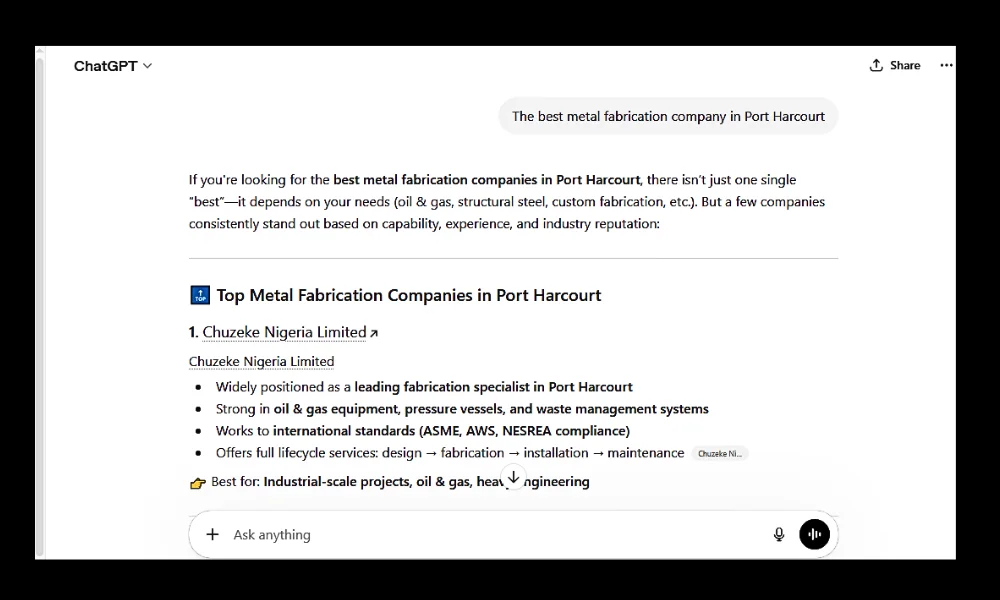
Generative Engine Optimization (GEO) is the practice of optimizing your website and content so that AI-powered search tools find, understand, and cite you when answering user questions. When someone types a query into ChatGPT or Google AI Mode, the AI does not show a list of links. It synthesizes a single answer by pulling information from multiple trusted sources across the web and cites those sources inline.
GEO is simply about making sure your brand is one of those cited sources.
The term was formally coined in the marketing community around 2023–2024 and grew into a recognized discipline by 2025, as AI search adoption accelerated rapidly. AI-referred web sessions grew 527% year-over-year in the first five months of 2025, according to Previsible’s 2025 AI Traffic Report. By the time Google published its first official guidance on optimizing for generative AI experiences in May 2026, GEO had become a standard part of any modern digital marketing plan.
How AI Platforms Decide What to Cite
Here is how it works technically. When a user submits a query to ChatGPT or Perplexity, the AI does not paste the full question into a single search. It breaks the question into smaller sub-queries and runs each one separately against the web. This is called query fan-out.
The AI then retrieves relevant passages from web pages using a technique called Retrieval-Augmented Generation (RAG). RAG pulls specific sections of text from indexed pages and feeds them to the language model, which then combines them into a single coherent answer. Your goal with GEO is to be one of the pages the AI retrieves and cites.
According to Google’s official AI Optimization Guide published on Search Central, the generative AI features in Google Search (including AI Overviews and AI Mode) rely on the same core Search ranking and quality systems as traditional organic results. Your content must rank well on Google before it can realistically appear in AI-generated summaries.
GEO, AEO, and GSO — What the Labels Mean
You may see several terms used interchangeably in this space: GEO (Generative Engine Optimization), AEO (Answer Engine Optimization), and GSO (Generative Search Optimization). The field is new enough that no single label has won out yet.
For practical purposes, they describe the same core goal: making your content the trusted source that AI platforms draw from when answering questions in your category. Google itself does not treat them as separate practices. In its own guidance, Google treats them as third-party labels for advice about AI search experiences and says the best practice remains foundational SEO done well, paired with structured, authoritative content.
How Traditional SEO Works
Traditional SEO gets your website pages to rank in Google’s search results pages (SERPs), so users see your link and click through to your site. It relies on keyword research, on-page structure, backlinks, technical performance, and content quality. A page ranked in position 1 on Google historically captured around 28–32% of all clicks for that query.
What SEO Gets You in 2026
SEO remains the foundation of all online visibility. In early 2025, Google processed over 14 billion searches per day, compared to ChatGPT’s 37 million, according to Contentful’s 2025 SEO analysis. That gap means you cannot afford to ignore traditional search rankings.
The challenge is that even a strong SEO ranking no longer guarantees clicks the way it once did. Google AI Overviews now appear in 23% of all Google searches and push organic results below the fold. Ahrefs’ research from 2025 found that AI Overviews reduced click-through rates for top-ranking content by 58%. Zero-click searches, where users get their answer from the AI summary without visiting any site, have risen significantly.
This is the exact problem GEO solves.
GEO vs SEO: The 5 Core Differences
Here is the clearest way to understand the relationship between the two disciplines.
1. Goal: Click vs Citation
SEO optimizes for a click. Your page appears in a list of results, and users choose whether to visit it. GEO optimizes for a citation. An AI generates a single synthesized answer and attributes part of that answer to your page, whether the user clicks through or not. The citation itself carries brand value.
2. Ranking vs Frequency of Mention
In SEO, you either hold a position (position 1, 2, 3) or you do not. The result is binary and relatively stable. In GEO, there is no fixed position 1 in ChatGPT or Perplexity.
AI responses are non-deterministic. Ask the same question five times, and you get five slightly different answers citing different sources. The metric that matters is citation frequency: how often your brand appears across many different AI responses to many different related prompts.
3. Keywords vs Entity Authority
SEO rewards keyword-targeted content that matches the exact phrase a user typed. GEO rewards entity authority based on how well AI systems recognize your brand as a credible, consistently described source across your website, third-party platforms, directories, reviews, and social media profiles. A business that maintains consistent descriptions of what it does, who it serves, and where it operates across all digital platforms builds the kind of entity that authority AI systems trust.
4. One Engine vs Multiple AI Platforms
SEO is primarily about Google (and to a lesser extent Bing). GEO requires optimizing for multiple AI platforms simultaneously: Google AI Overviews, ChatGPT Search, Perplexity, Claude, Gemini, and any new AI tool that emerges.
Each platform weights signals differently. Perplexity performs real-time web retrieval for every query and rewards freshness. ChatGPT Search favors authoritative, encyclopedic content and third-party trust signals from review platforms like Clutch and Google Business Profile. Google AI Overviews primarily cite pages that already rank in the organic top 10.
5. Traffic Volume vs Conversion Quality
SEO traffic comes in higher volume. GEO traffic comes in lower volume but higher quality. According to Backlinko’s 2025 analysis, companies that appeared in AI-generated answers saw conversion rates 27% higher than standard organic visitors. One analysis by The Washington Post found that visitors arriving via AI platform citations converted to paid subscriptions at 4–5 times the rate of traditional search visitors.
Visitors from AI citations arrive already familiar with your brand and already partially convinced by the AI’s endorsement.
Next steps: the question is not whether to choose SEO or GEO. The answer is that you need both, and your website needs to be built for both from the start.
Why GEO Matters for Nigerian Businesses Right Now
The AI Search Shift in Numbers
Nearly 31% of the US population used generative AI search in 2026, according to EMARKETER. ChatGPT processed 2.5 billion prompts per day as of mid-2025. Google AI Overviews now span 200+ countries in 40+ languages, including Nigeria. Any Nigerian business operating online is already subject to GEO, whether its website is ready for it or not.
The early mover advantage is significant. Right now, only 1.2% of businesses appear in AI-generated local recommendations, according to SOCi’s 2026 Local Visibility Index. That means 98.8% of businesses are invisible to users who search with AI tools. For Nigerian businesses, where digital competition is growing fast in cities like Port Harcourt, Lagos, Abuja, and Uyo, getting cited by AI platforms before competitors do builds an advantage that compounds over time.
The Nigeria Advantage in AI Search
AI systems reward clarity, expertise, structured information, and verifiable authority, not just budget and brand size. A focused Nigerian agency or business that publishes well-structured, fact-backed, locally authoritative content can appear in AI citations alongside or ahead of much larger global competitors. According to research on GEO for Nigerian entrepreneurs (Mauco Enterprises, 2026), “AI systems reward depth over visibility, expertise over performance, and substance over self-promotion.”
This is an opening Nigerian businesses should not leave on the table.
What a GEO-Optimized Website Looks Like
Content Structure for AI Citation
AI platforms do not read content the way humans do. They look for specific structural patterns that signal authority and extractability.
Answer-first paragraphs: AI systems look for content that leads with a direct, factual answer in the first 40–60 words of each section, then adds supporting detail. A page that buries its main point after three paragraphs of context rarely gets cited.
Fact density: Content with specific, sourced data points gets cited 30–40% more frequently than content without, according to research published on To The Web (2026). Every major section should carry at least one data point linked to its source.
Named authorship and dates: LLMs strongly favor content published by credible, named authors with visible credentials and clear publication dates. Anonymous or undated content performs significantly below average in AI citation frequency.
FAQ sections with schema: FAQ schema markup has shown up to a 3x lift in AI citation rates in testing. When your page answers specific questions in a clean Q&A structure with proper FAQ schema, AI platforms can extract and attribute those answers precisely.
Content freshness: When content becomes more than 3 months old, AI citation rates drop sharply. GEO-optimized pages need quarterly content reviews to stay current.
Schema Markup and Structured Data
Schema markup (JSON-LD) is the single fastest technical win for AI visibility. It gives AI crawlers machine-readable context about your business: what you do, who you serve, where you are, and why you are credible. For a Nigerian web design agency, the priority schema types are: Organization, LocalBusiness, Article, FAQPage, BreadcrumbList, and Website.
Google’s official guidance confirms that structured data helps products and services appear in both AI responses and traditional search results. A Google Business Profile, kept current and complete, also directly feeds into Google AI Overviews for local queries.
Technical Signals AI Engines Trust
Page speed: Research from 2026 shows pages with First Contentful Paint (FCP) under 0.4 seconds average 6.7 AI citations, compared to just 2.1 citations for pages with FCP over 1.13 seconds, a 3x difference from speed alone, according to JDM Web Technologies’ 2026 analysis.
Crawl accessibility: If your robots.txt file blocks AI crawlers (GPTBot, ClaudeBot, PerplexityBot), you are completely invisible to those platforms regardless of your content quality. AI-ready websites explicitly allow these crawlers.
Clean semantic HTML: AI systems tokenize your HTML and process it for semantic meaning. A site built with proper heading hierarchy (H1 → H2 → H3), explicit HTML5 semantic elements, and clean code structure is far easier for AI to extract and cite than a page built with generic div containers and inconsistent structure.
Backlink profile: AI models use live web search to find sources. Pages with strong backlink profiles rank higher in the sub-queries AI generates during the query fan-out process.
More links also mean more appearances in Common Crawl, the public dataset that most large language models train on, which increases the AI’s familiarity with your brand.
SEO + GEO Together: The Smart Strategy for 2026
GEO does not replace SEO. It builds on top of it. According to industry analysis published by LLMrefs in March 2026, 99% of AI Overviews cite pages that already appear in the organic top 10 for that topic. Without strong SEO, you will not appear in AI answers.
Here is the relationship: SEO gets you discovered. GEO gets you cited.
Think of it this way. Traditional SEO is like placing road signs around a city. GEO is like being the business a trusted hotel concierge recommends by name when a guest asks for the best option nearby. By the time the customer reaches you, the AI platform has already established your authority on their behalf.
Between now and 2028, analysts estimate that traditional SEO will account for roughly 60% of search-driven traffic, while AI-mediated searches will account for roughly 40%. Ignoring either approach risks losing up to 50% of organic demand potential, according to SEOgroup analysis published in 2026.
Start with SEO; Build with GEO
If your website is brand new or underperforms in Google search today, the right starting point is SEO: solid technical structure, proper on-page optimization, mobile performance, and quality content. GEO built on a weak SEO foundation will not hold.
Once your site has solid SEO foundations in place, GEO is the layer you add: answer-first content structure, FAQ schema, named authorship, consistent entity descriptions across platforms, third-party directory presence (Clutch, Google Business Profile, relevant Nigerian business directories), and regular content refreshes every 90 days.
How Atelier Builds Websites That Rank on Google and Get Cited by AI
At Atelier Website Design Agency, we build custom websites for Nigerian businesses that are engineered from day one to perform in both traditional search and AI-generated results. Most web design agencies in Port Harcourt and Nigeria as a whole build a site that looks good and hand it to you. We do something different.
Every Atelier website ships with:
- Clean semantic HTML structure that AI crawlers can read and extract efficiently
- Proper heading hierarchy, schema markup (Article, Organization, LocalBusiness, FAQPage), and metadata built in from the first page
- Page speed optimized to pass Google’s Core Web Vitals and meet the FCP thresholds that drive AI citation rates
- Answer-first content blocks on service pages so AI platforms can cite your specific services, location, and expertise
- GBP integration guidance so your Google Business Profile feeds correctly into Google AI Overviews for local queries in Port Harcourt, Lagos, Abuja, Uyo, or your preferred city.
- AI crawler accessibility confirmed in robots.txt and llms.txt, so GPTBot, ClaudeBot, and PerplexityBot can index your content
Our SEO and GEO services go beyond the build. We offer local SEO and GEO services for Nigerian businesses that want to dominate both the Google SERP and the AI-generated answers that increasingly shape how customers find services in Port Harcourt and across Nigeria.
Our GEO-Optimized Web Design Process
Here is how we approach every project:
- Strategy session – We map your target queries across both traditional search and AI prompt patterns: the questions your customers ask Google and the questions they ask ChatGPT.
- Entity architecture – We define your brand’s entity profile: what your business is, what it does, who it serves, and where it operates. This description is made consistent across your website, GBP, and any directory listings we recommend.
- Content structure – We write or brief every page with answer-first paragraphs, data citations, named authorship, and FAQ sections with schema.
- Technical implementation – We build on WordPress with JSON-LD schema, semantic HTML5, Core Web Vitals-optimized performance, and explicit AI crawler permissions.
- Quarterly content refresh – We flag pages for updates every 90 days to maintain the content freshness signals that AI platforms reward.
Want a website that works for both Google and AI? Contact Atelier today and let us build your digital presence for the next decade of search.
Frequently Asked Questions About GEO and SEO
What is Generative Engine Optimization (GEO)?
Generative Engine Optimization (GEO) is the practice of optimizing your website content so that AI platforms like ChatGPT, Perplexity, Google AI Overviews, and Claude cite your business in their AI-generated answers. The goal is to be the trusted source the AI draws from, not just a link in a list of results.
How is GEO different from SEO?
SEO focuses on ranking in traditional search engine results pages to earn clicks. GEO focuses on being cited inside AI-generated responses. SEO targets click volume; GEO targets citation frequency and conversion quality. Both are needed in 2026 — strong SEO is the foundation that makes GEO possible.
Does GEO replace SEO?
No. GEO builds on top of SEO. AI platforms primarily cite pages that already rank well in traditional search. A weak SEO foundation will limit your GEO results. The winning strategy in 2026 combines both: SEO gets you found, GEO gets you cited.
How do I get my Nigerian business cited by ChatGPT or Perplexity?
Start with a well-structured website that passes Core Web Vitals, uses proper schema markup, and publishes answer-first content with verifiable data and named authorship. Make sure AI crawlers are permitted in your robots.txt file. Build consistent entity descriptions across your website, Google Business Profile, and relevant directories. Then update your most important pages every 90 days to maintain freshness.
What is the difference between GEO, AEO, and GSO?
These terms: GEO (Generative Engine Optimization), AEO (Answer Engine Optimization), and GSO (Generative Search Optimization), describe overlapping practices. No universal standard exists yet. Google treats them as third-party labels for the same underlying work: creating structured, authoritative content that AI systems can extract and reference. In practice, treat them as the same discipline.
Does GEO work for small businesses in Port Harcourt or Lagos?
Yes. AI systems reward content clarity, local expertise, and structured authority, not budget or brand size. A Nigerian business that publishes well-structured, locally authoritative content with consistent entity descriptions can appear in AI citations ahead of much larger national or international competitors. Early movers in Nigerian cities gain a compounding advantage as AI search grows.
How long does GEO take to produce results?
GEO results emerge more gradually than paid advertising but compound over time. Citation authority builds as AI platforms encounter your brand across more contexts and platforms. Most businesses see measurable AI citation increases within 3–6 months of implementing GEO-optimized content and technical changes. The earlier you start, the longer your authority compounds before competitors catch up.
Add a Comment